French tip nails are one of the easiest nail designs to recognize, but getting clean, even tips at home can take the right products. A good French manicure does not require a huge collection of nail supplies. With a few basic tools, you can create neat white tips, soft pink French tips, micro French nails, and many other French tip styles from home.
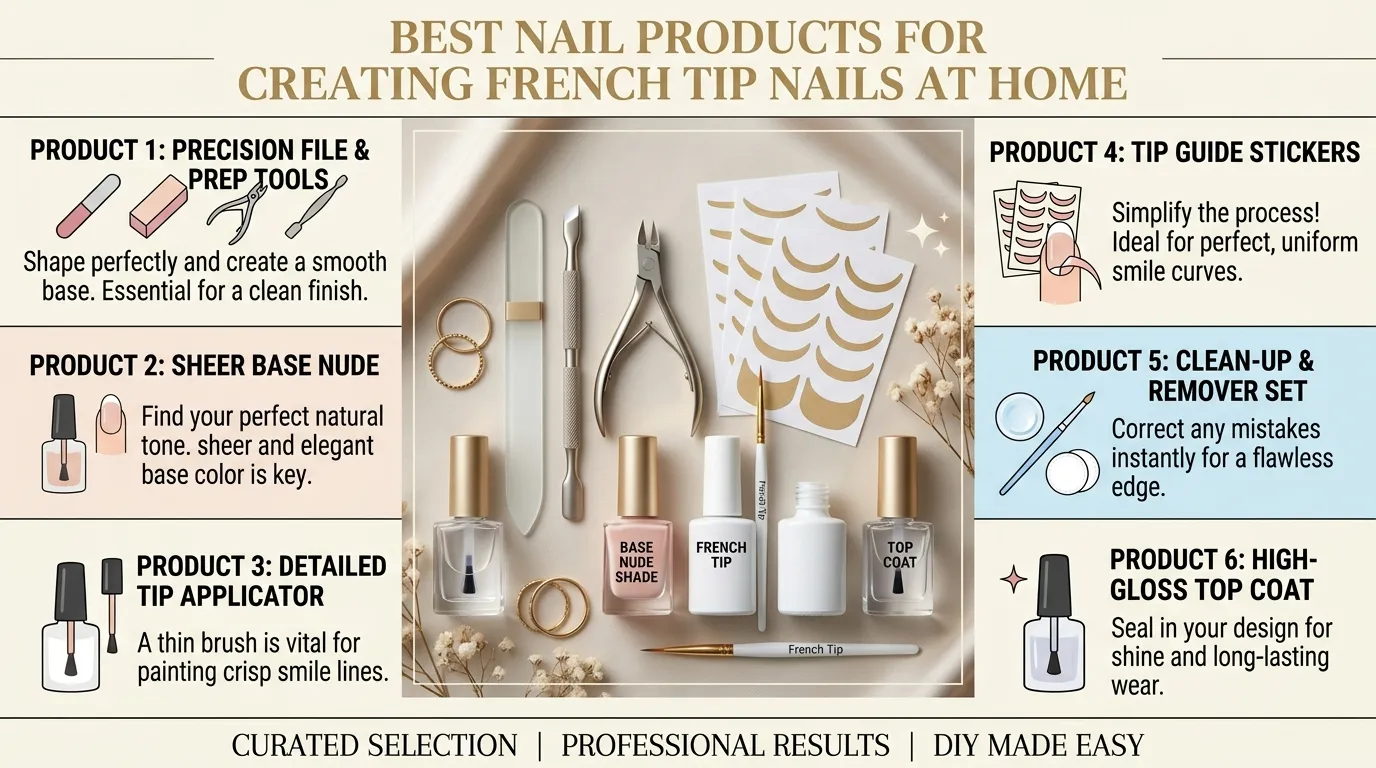
The most important products are a base coat, sheer pink or nude polish, white nail polish, top coat, nail file, nail art brush, and French tip guides. If you are using gel polish, you will also need a suitable LED or UV lamp.
Professional nail brands such as OPI and essie also recommend starting with clean, prepared nails, applying thin layers, and finishing with a top coat for a smoother and longer-lasting manicure.
This guide explains what each product does, what to look for when buying it, and which supplies are most useful for beginners.
Quick List of the Best Products for French Tip Nails
If you want to build a simple French tip nail kit, start with these products:
| Nail Product | Why You Need It | Best For |
|---|---|---|
| Nail polish remover | Removes old polish and oils | Nail preparation |
| Nail file | Shapes the nails | Creating an even nail shape |
| Buffer | Smooths the nail surface | Smoother application |
| Cuticle pusher | Helps tidy the cuticle area | Nail preparation |
| Base coat | Creates a good foundation | Polish adhesion |
| Sheer pink polish | Creates the natural French base | Classic French manicure |
| Nude polish | Gives a warm natural base | Nude French tips |
| White nail polish | Creates the French tip | Classic white tips |
| French tip guides | Helps create an even smile line | Beginners |
| Fine nail art brush | Creates precise lines | Freehand French tips |
| Cleanup brush | Fixes uneven edges | Crisp smile lines |
| Top coat | Seals the manicure | Shine and protection |
| Cuticle oil | Moisturizes the nail area | Finishing care |
| LED/UV lamp | Cures gel products | Gel French tips |
1. White Nail Polish for French Tips
White nail polish is the most important color for a traditional French manicure. The classic design usually combines a natural-looking pink, nude, or sheer base with a white tip.
When choosing white polish, look for a formula that is:
- Smooth and easy to control
- Pigmented enough to cover the tip
- Not too runny
- Easy to apply in a thin layer
- Suitable for nail art
A highly opaque white can be helpful for beginners because you may not need several coats to get a visible French tip.
A softer white can also create a more natural French manicure. This is useful if you want your nails to look less bright and more delicate.
For example, essie’s Blanc is specifically described by the brand as suitable for creating a French manicure edge.
The goal is not simply to find the whitest polish. You want a white shade that gives you enough control to create a clean smile line.
2. Sheer Pink Nail Polish
A sheer pink nail polish is another essential product for classic French tip nails.
Instead of leaving the natural nail completely bare, a sheer pink shade gives the nail a soft and polished appearance. It can also help make the white tips stand out without making the manicure look too heavy.
Look for shades described as:
- Sheer pink
- Milky pink
- Soft pink
- Ballet pink
- Natural pink
- Pink nude
- Blush pink
For a traditional French manicure, the base should usually remain fairly transparent or natural-looking.
If you want a very clean and modern appearance, choose a milky pink. If you want a warmer appearance, choose a peachy nude.
3. Nude Nail Polish
Nude nail polish is a great alternative to pink for French tips.
It works especially well when you want a slightly warmer or more natural manicure. Nude French tips can also be used with different white shades to create subtle nail designs.
Popular nude families include:
- Beige
- Cream
- Peach nude
- Caramel nude
- Pink beige
- Soft tan
The best nude shade depends on the look you want. You do not need to match your skin tone perfectly. A shade that is close to your natural nail color can create a soft and balanced French manicure.
4. Base Coat
Do not skip the base coat when using regular nail polish.
A base coat creates a foundation between your natural nail and the color. It can also help polish apply more evenly and improve adhesion.
essie recommends base coat as part of its traditional nail polish system, while its guidance also explains that different polish formulas can have different base-coat requirements.
A good base coat should:
- Apply smoothly
- Dry without staying overly wet
- Help color adhere
- Create an even surface
- Work with your chosen polish
If your nails are weak or prone to peeling, you can also look for a strengthening base coat.
5. Glossy Top Coat
A top coat is one of the most useful products in a French manicure kit.
After you finish your white tips and base color, the top coat seals the design and adds shine. It can also help protect the manicure from everyday wear.
essie describes top coat as a finishing layer that helps seal color and add shine, while OPI uses a top coat as the final step in its at-home French gel system.
For classic French tip nails, a high-shine top coat is usually a good choice.
You can also choose a matte top coat if you want a modern French manicure.
6. Fine Nail Art Brush
A fine nail art brush is one of the best tools to have if you want to learn freehand French tips.
The brush gives you more control than the standard brush inside a nail polish bottle. You can use it to:
- Draw the smile line
- Create micro French tips
- Fix uneven edges
- Create colorful French tips
- Add small nail art details
A detail brush is also recommended in OPI’s French manicure tutorial for creating the smile line.
For beginners, a short or medium-length detail brush can be easier to control than an extremely long liner brush.
7. Angled Nail Art Brush
An angled brush can make French tip application easier because the angled edge can help you create a curved line.
It is particularly useful for:
- Classic French tips
- Deep French tips
- Side French tips
- Short nails
- Curved smile lines
You can apply a small amount of white polish to the brush and carefully work around the tip instead of trying to create the entire curve in one movement.
8. French Tip Guide Stickers
French tip guide stickers are especially useful for beginners.
These small curved stickers help separate the nail tip from the base color. You place the guide across the nail, apply your white polish to the exposed area, and then remove the guide.
They can help when:
- Your hands are not very steady
- You are new to French manicures
- You want similar curves on every nail
- You are working on both hands
- You want to create a classic curved French tip
However, the guide must sit flat against the nail. Any gap can allow polish to move underneath the sticker.
For that reason, let your base color dry properly before applying guides.
9. French Tip Nail Stamper
A French tip nail stamper is another option if you struggle with freehand lines.
Instead of painting the smile line directly onto the nail, a silicone stamping tool transfers the curved shape onto the nail.
This can be useful for beginners who want consistent curves without drawing each line manually.
A stamper can also save time when you want the same French tip style across several nails.
10. Cleanup Brush
Even experienced nail artists can get polish outside the desired line.
That is why a small cleanup brush is worth keeping in your French manicure kit.
A cleanup brush can help remove:
- Extra white polish
- Polish around the cuticle
- Uneven smile lines
- Small polish mistakes
- Color that touches the skin
For regular polish, a small brush used with an appropriate nail polish remover can help clean the edges. essie also recommends using a nail art or makeup brush with remover for cleaning unwanted polish around the nail.
This simple tool can make a big difference in the final appearance.
11. Nail File
A good nail file should be part of every at-home manicure kit.
French tips look cleaner when all nails have a similar length and shape.
Common shapes for French tip nails include:
- Square
- Squoval
- Round
- Oval
- Almond
- Coffin
You do not need a particular nail shape to wear French tips. The design can be adjusted to different nail lengths and shapes.
OPI recommends shaping nails as part of its at-home manicure preparation, while its French manicure guide also emphasizes nail preparation before applying color.
12. Nail Buffer
A nail buffer can help smooth small surface imperfections before applying polish.
Use it gently. The purpose is to create a smoother surface, not to aggressively thin the natural nail.
A smooth nail plate can make your base color look more even, especially when using sheer pink or milky shades.
If your nails already have a smooth surface, you may not need frequent buffing.
13. Cuticle Pusher
A cuticle pusher is useful during nail preparation.
Keeping the cuticle area neat can make your French manicure look cleaner and give you more space to apply polish without touching the surrounding skin.
Use gentle pressure rather than forcing the cuticle backward.
Good preparation is an important part of an at-home manicure. OPI includes cuticle preparation, shaping, and cleansing in its manicure routine.
14. Nail Polish Remover
Nail polish remover has two jobs in a French manicure routine.
First, it removes old polish before you start.
Second, it can help you clean mistakes around the nail.
Before applying your base coat, your nails should be clean and free from leftover polish, heavy oil, and other residue. essie recommends cleansing the nails before starting a French manicure because residue can contribute to problems such as chipping.
Keep a small amount of remover nearby while doing your French tips so you can quickly correct mistakes.
15. Cuticle Oil
Cuticle oil is a simple finishing product that can make your hands and nail area look more cared for.
After your manicure is completely finished and dry, apply a small amount around the cuticles and massage it gently.
OPI also includes cuticle oil as a final step in its professional gel French manicure routine.
Look for cuticle oils containing ingredients commonly used for moisturizing, such as jojoba oil or vitamin E.
Best French Tip Products for Beginners
If you are doing French tips for the first time, you do not need to buy everything listed above.
A simple beginner kit can include:
- Nail file
- Nail polish remover
- Base coat
- Sheer pink or nude polish
- Opaque white polish
- French tip guide stickers
- Cleanup brush
- Glossy top coat
- Cuticle oil
This setup gives you almost everything needed for a classic French manicure.
Once you become more comfortable, you can add a fine nail art brush and start practicing freehand French tips.
Best French Tip Products for Freehand Nail Art
If you want to create French tips without stickers, focus on your brushes.
Your basic freehand kit can include:
- Fine liner brush
- Angled brush
- Cleanup brush
- White nail polish
- Sheer pink polish
- Base coat
- Top coat
The fine brush helps create the smile line, while the cleanup brush can correct the edges.
A useful technique is to paint slightly more white than you need and then clean the curve with a small brush. This allows you to shape the smile line instead of trying to make it perfect in one stroke.
Best Products for Short French Tip Nails
Short nails look beautiful with French tips, but very thick white tips can make the nail look crowded.
For short nails, consider:
- A thin white polish brush
- Fine nail art brush
- Micro French tip guides
- Sheer pink base
- Milky nude polish
- Glossy top coat
A micro French tip is especially useful for short nails because the white line is kept narrow.
Keep the tip thin and follow the natural shape of the nail.
Best Products for Gel French Tip Nails
If you prefer gel French tips, you will need a different setup.
A basic gel French manicure kit can include:
- Gel base coat
- Sheer pink or nude gel polish
- White gel polish
- Gel top coat
- Fine detail brush
- Nail cleanser
- Lint-free wipes
- LED or UV lamp
- Cuticle oil
Always follow the curing instructions supplied with your specific gel system. OPI’s at-home gel French manicure, for example, uses a base coat, neutral shade, white tip color, LED lamp curing, and a no-wipe top coat.
Do not mix gel systems casually. Follow the manufacturer’s instructions for the products and lamp you are using.
Regular Polish vs Gel Polish for French Tips
Both regular nail polish and gel polish can be used to create French tips.
| Feature | Regular Polish | Gel Polish |
|---|---|---|
| Requires lamp | No | Usually yes |
| Easy to remove | Yes | Requires proper gel removal |
| Drying method | Air dry | LED/UV curing |
| Good for beginners | Yes | Yes with correct setup |
| Nail art | Excellent | Excellent |
| Equipment needed | Less | More |
| Finish | Glossy or matte | Usually very glossy |
| Best for | Simple DIY manicure | Longer-wear gel manicure |
For a first attempt, regular polish may be easier because you do not need a lamp or gel-specific products.
How to Choose the Right White Polish
Not every white nail polish works equally well for French tips.
When shopping, check for:
Good opacity: You want the tip to show clearly without many thick coats.
Good control: A polish that spreads too quickly can make the smile line difficult to control.
Smooth formula: Smooth polish is easier to apply evenly.
Suitable brush: A controlled brush can make tip application easier.
Finish: Choose glossy, creamy, sheer, or another finish depending on your desired design.
For example, essie describes Blanc as a white shade that can be swept across the tips for a French manicure edge.
How to Choose the Right Base Color
Your base color changes the entire appearance of a French manicure.
For a classic look, choose:
- Sheer pink
- Soft beige
- Milky pink
- Natural nude
- Pale peach
For a modern French manicure, you can also experiment with:
- Milky white
- Soft lavender
- Baby pink
- Transparent beige
- Light mocha
The base should usually be subtle enough that the French tip remains the main focus.
How to Make French Tips Look Cleaner
The right products help, but application technique matters just as much.
Start with clean, dry nails.
Apply thin coats rather than thick layers. essie’s manicure guidance recommends thin layers and allowing appropriate drying time between coats.
When applying the white tip:
- Keep the amount of polish on your brush controlled.
- Follow the natural curve of the nail.
- Avoid putting too much polish near the sidewalls.
- Use a cleanup brush for small mistakes.
- Let the manicure dry properly.
- Finish with top coat.
For a longer-lasting manicure, remember to seal the free edge when your product instructions allow it. essie specifically recommends wrapping or capping the free edge as part of its manicure advice.
How to Build a French Tip Nail Kit on a Budget
You do not need expensive products to start.
A budget-friendly kit can contain:
- Basic nail file
- Regular nail polish remover
- Affordable base coat
- One sheer pink polish
- One white polish
- Small nail art brush
- French tip stickers
- Basic glossy top coat
- Cuticle oil
Start with these products before buying specialty tools.
Once you know which French tip technique works best for you, you can upgrade your brushes, polish colors, guides, or gel system.
Products You Can Skip at First
A large nail collection can be tempting, but many products are not necessary for a basic French manicure.
You can skip these at first:
- Large nail art kits
- Dozens of nail colors
- Expensive electric nail tools
- Multiple stamping plates
- Large collections of rhinestones
- Several different top coats
- Professional salon equipment
Focus on the basics first.
A small collection of good, useful products is usually easier for a beginner to manage.
Where to Learn More About French Manicure Techniques
If you want another professional reference for creating French tips, OPI has an at-home French manicure tutorial that covers nail preparation, base color, white tips, and top coat application.
You can also see essie’s French manicure guide for advice on nail preparation, sheer base colors, creating the smile line, cleanup, and finishing with top coat.
Common French Tip Nail Mistakes to Avoid
A few simple mistakes can make a French manicure look uneven.
Using Too Much White Polish
A thick layer can become difficult to control and may take longer to dry.
Making Every Tip Too Wide
A very wide white tip can overpower short nails.
Skipping Nail Preparation
Oil and residue can affect how polish adheres.
Using a Dirty Brush
Old polish on your brush can create rough lines.
Touching the Nail Plate
Oil from your fingers can transfer onto the nail after cleaning.
Rushing Between Coats
Give each layer enough time to dry or cure according to the product instructions.
Forgetting the Top Coat
The top coat helps seal the design and provides the final finish.
French Tip Nail Products Checklist
Before starting your manicure, use this checklist:
- Nail polish remover
- Nail file
- Buffer
- Cuticle pusher
- Base coat
- Sheer pink or nude polish
- White polish
- French tip guides
- Fine nail art brush
- Cleanup brush
- Top coat
- Cuticle oil
- LED/UV lamp if using gel
You do not need every item. Choose the products that match your preferred French tip technique.
Frequently Asked Questions
What products do I need for French tip nails at home?
For a basic French manicure, you need a nail file, base coat, sheer pink or nude polish, white nail polish, top coat, and a nail art brush or French tip guides. Nail polish remover and cuticle oil are also useful.
What is the best white nail polish for French tips?
Look for a white polish that is opaque, smooth, and easy to control. A creamy white is a popular choice for classic French tips, while a softer white can create a more natural appearance.
Do I need French tip guide stickers?
No. French tip guides are optional. They can make the process easier for beginners, but you can also create the smile line with a fine nail art brush.
Can I do French tips on short nails?
Yes. French tips work well on short nails. For a smaller nail plate, try a thin or micro French tip instead of a wide white tip.
Is a base coat necessary for French tip nails?
A base coat is generally recommended when using traditional nail polish because it creates a foundation for the color and can help with adhesion. However, always follow the instructions for the specific polish system you use.
Do I need a top coat for French tips?
A top coat is highly useful because it seals the manicure, adds shine, and can help protect the design from everyday wear.
What brush should I use for French tips?
A fine detail or liner brush works well for drawing the smile line. An angled brush can also help with curved tips, while a small cleanup brush is useful for correcting the edges.
Can I use regular nail polish for French tips?
Yes. Regular nail polish works very well for French tip nails and does not require a UV or LED lamp.
Is gel polish better for French tips?
Gel polish is another option and can provide a glossy, cured finish, but it requires the correct gel products and curing lamp. Follow the manufacturer’s instructions for your gel system.
What color should I use under white French tips?
Sheer pink, milky pink, nude, beige, and soft peach are popular choices. For a classic French manicure, a sheer pink or natural-looking shade works especially well.
How do I make French tips look even?
Try using French tip guides if you are a beginner. If you paint freehand, create the same starting points on each side of the nail and build the curve slowly. A cleanup brush can also help make the final smile line more even.
How can I make my French manicure last longer?
Start with clean nails, use thin layers, allow each layer to dry properly, and finish with a suitable top coat. Sealing the free edge can also help reduce chipping.
Final Thoughts
Creating French tip nails at home becomes much easier when you have the right products.
You do not need a professional salon setup. A good base coat, sheer pink or nude polish, opaque white polish, top coat, nail file, and either French tip guides or a nail art brush are enough to get started.
If you are new to French manicures, begin with guide stickers. Once you become comfortable with the shape, try a fine nail art brush and practice creating the smile line yourself.
The most important thing is to choose products that are easy to control and to give yourself enough time for each layer to dry or cure. With practice and a simple nail kit, you can create clean, beautiful French tip nails at home.