Table of Contents
- Introduction
- What Are Floral Nails?
- 25 Ideas at a Glance
- 25 Designs to Try
- How to Choose Your Floral Design
- How Floral Art Wears
- FAQs
- Final Thoughts
Some nail art is a pattern. Floral nails are a garden — the oldest decoration in beauty, rebuilt on the newest base. A flower can be almost anything on a nail: five dots and a centre, a rose painted petal by petal, a real dried bloom sealed under glass-clear gel, a tiny sculpted blossom standing off the surface. Put any of them on a French tip and the contrast is the charm — the cleanest, most classic base in nail design, carrying the softest art there is.
That is what this guide is about. Below you will find 25 floral designs, each one photographed and explained in simple words: pink accent sets and tiny red flowers, tone-on-tone white florals, daisies and hand-painted roses on French tips, sunflowers, lavender, cherry blossom, pressed real flowers, and the black manicures that make white roses glow. Wrapped around them is the knowledge that decides whether a floral set looks like a garden or a sticker sheet: the four ways flowers are actually made and how honest each one is about skill, which flower suits which nail, how busy a set should be, and how to protect painted, pressed and sculpted blooms once they are on.
One honest note before the pretty photos: flowers forgive. A slightly uneven petal still reads as a petal — nature never grows two flowers alike — which makes floral art the friendliest serious nail art there is, and the reason it survives every trend cycle. What changes between designs is not the flower but the technique: painted, decal, pressed and sculpted flowers are four different manicures wearing the same garden. The garden’s other resident arrived yesterday — our butterfly nails design ideas pair with almost everything below, and design 17 there is this article’s closest relative.
What Are Floral Nails? Painted, Pressed, Printed or Sculpted
Floral nails are any manicure where a flower — a whole bloom, a single petal cluster, or a sprig — is the art. On a French tip the flowers usually live on one or two accent nails or along the smile line, because the sheer base and clean white edge give petals a quiet stage. But how the flower gets onto the nail changes everything about the appointment, the price and the wear:
| Technique | How it is done | Skill needed | What it looks like | Durability |
|---|---|---|---|---|
| Hand-painted | A fine brush or dotting tool builds the flower petal by petal in gel paint — five-dot daisies at the simple end, shaded roses at the master end | Low for dot flowers; high for realistic blooms | One of a kind; soft, organic, slightly irregular in the way real flowers are | The full life of the set (2–3 weeks in gel) — the art is the surface, sealed under top coat |
| Decals & stickers | A printed water decal or sticker flower is placed on the cured base and sealed under top coat | Low — placement and patience, not drawing | Perfectly even, detailed flowers; identical on every nail if you want them to be | 1–2+ weeks when fully sealed edge-to-edge; a lifted edge is the weak point |
| Dried flowers, encapsulated | Real dried micro-flowers are laid on the nail and buried under clear gel or acrylic — the pressed-flower or “milk bath” technique | Medium — the flowers are fragile and placement is fiddly | Real blooms with real depth, floating inside glass; nothing else looks like it | Excellent once sealed — nothing protrudes, so nothing snags; lasts the full life of the enhancement |
| 3D sculpted | Builder gel or acrylic is shaped into raised petals on the nail, or pearl/gem beads are arranged into a flower and set in gel | Medium for bead flowers; high for sculpting | Real dimension — a blossom you can feel, jewellery that happens to be a manicure | Small, base-seated pieces last well; tall petals catch on hair and knitwear — occasion wear, honestly |
Mainstream coverage keeps confirming the same four-way split. Allure’s guide to spring floral nail art builds its whole report on texture — jelly finishes that give petals a translucent depth, 3D embellishments, and “even actual flowers encased in clear polish” — and its nail artist Annie Ngo gives the placement rule this article follows: her favourite floral art is “more of a random, uneven placement”, mixed with French tips to add depth “while still keeping it delicate”. Perfectly symmetrical flowers are a decal’s job; painted gardens are supposed to wander a little.
The flower chooses the technique. Small, graphic flowers — daisies, five-petal blossoms, tiny sprigs — paint beautifully and are the honest DIY route (designs 14, 16, 22). Detailed blooms — roses, peonies, cherry blossom branches — belong to a pro’s brush or a good decal sheet (15, 21). Real texture belongs to dried flowers (20), and real height belongs to sculpted work, whose full world — petal-by-petal acrylic flowers included — lives in our 3D nails design ideas. And every flower in this list sits on a French base for the same reason: the clean smile line is a frame, and a frame makes even five dots look like art.
25 Floral Nails Design Ideas at a Glance
| # | Design | Technique / finish | Best shape & length | Best for |
|---|---|---|---|---|
| 1 | Pink Floral Accent Nails | Pink gloss, painted floral accents | Medium | The soft pink opener |
| 2 | White Nails with Tiny Red Flowers | White gloss, micro red flowers | Medium | Bold colour, tiny art |
| 3 | White Floral Nail Art with Lilacs | White on white, floral art | Medium | Tone-on-tone softness |
| 4 | Pastel Nails with Baby’s Breath Styling | Multicolour pastel gloss | Medium | Pastel sets, styled soft |
| 5 | Blue Nails with a Pink Peony | Blue gloss, peony colour story | Medium | Blue-and-pink palettes |
| 6 | Light Blue Floral Art Nails with Roses | Light blue, white floral art | Medium | White art on colour |
| 7 | Mint Nails with Pink Blossom | Mint gloss, blossom palette | Medium | Mint and pink pairings |
| 8 | Pink Nails with a Daisy | Pink gloss, daisy styling | Medium | Daisy lovers, first florals |
| 9 | Classic French Manicures with White Roses | Classic French, group styling | Medium | The clean French canvas |
| 10 | Pink-Tipped Nails on an Open Book | Pink French tips, floral styling | Medium | Coloured tips, quiet days |
| 11 | Black French Tips Among Green Leaves | Black French, tiny white details | Medium | Dark French, micro detail |
| 12 | Black Nails Holding a White Rose | Black gloss, white rose story | Medium | Maximum contrast |
| 13 | Black Nails with White Roses | Black gloss, bouquet styling | Medium | White-on-black florals |
| 14 | White Daisy French Tips | White tips, tiny painted daisies | Medium | The classic floral French |
| 15 | Hand-Painted Rose French Tips | Nude French, painted pink roses | Almond, medium | Romantic painted blooms |
| 16 | Tiny Flowers on Milky French Tips | Milky French, micro flower sprinkle | Medium | A meadow in miniature |
| 17 | Floral Accent Ring Finger French | Nude French, one floral nail | Medium | The one-nail rule |
| 18 | Sunflower French Tips | French tips, sunflower art | Medium | Pure cheerfulness |
| 19 | Lavender Floral French Tips | French tips, lavender-purple art | Medium | Soft purple gardens |
| 20 | Pressed Flower Clear Nails | Clear gloss, real flowers sealed in | Medium | The pressed-flower look |
| 21 | Cherry Blossom French Tips | Pink French, cherry blossom art | Almond, medium | Blossom season, any season |
| 22 | Floral French Tips on Short Square Nails | Short square French, tiny flower | Short square | Everyday, busy hands |
| 23 | Autumn Floral Styling Nails | Burgundy and rust gloss | Medium | Rich autumn palettes |
| 24 | Tropical Hibiscus French Tips | French tips, pink hibiscus art | Medium | Vacation and summer sets |
| 25 | Floral French Tips with Gold Foil | Nude French, flowers + gold foil | Medium | Understated luxury |
25 Floral Nails Design Ideas to Try
1. Pink Floral Accent Nails
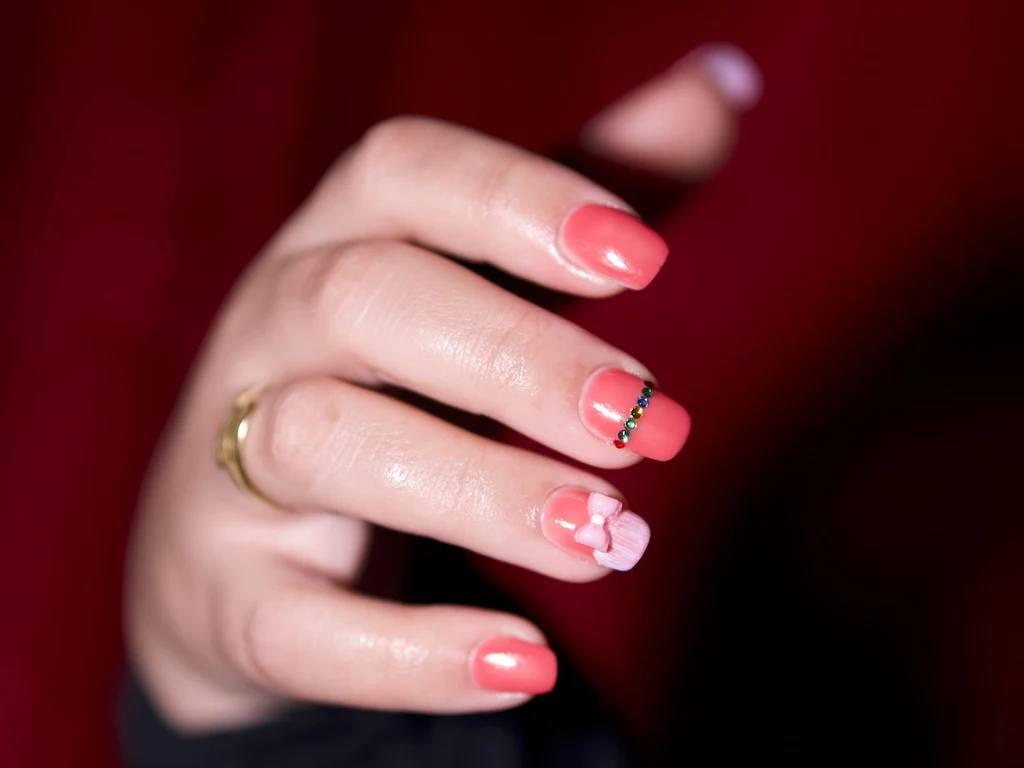
A real photograph to open the list: a pink manicure in close-up with delicate floral accents, against a dark background that makes the soft colour glow. This is the classic floral formula at its most wearable — a pretty base doing most of the work, flowers appearing only as accents, small enough to be discovered rather than announced. It is also the easiest design here to translate to a French tip: keep the pink as the base or the tip colour, and let one or two nails carry the same delicate blooms. If this close-up is your standard, the word at booking is “accent” — the flowers are guests, not the whole party.
Best for: pink devotees, first floral sets and soft everyday glamour.
Salon tip: floral accents photograph darker against a dark background than they look in daylight. If you are matching this photo, ask for the petal colour one shade lighter than the picture suggests.
2. White Nails with Tiny Red Flowers
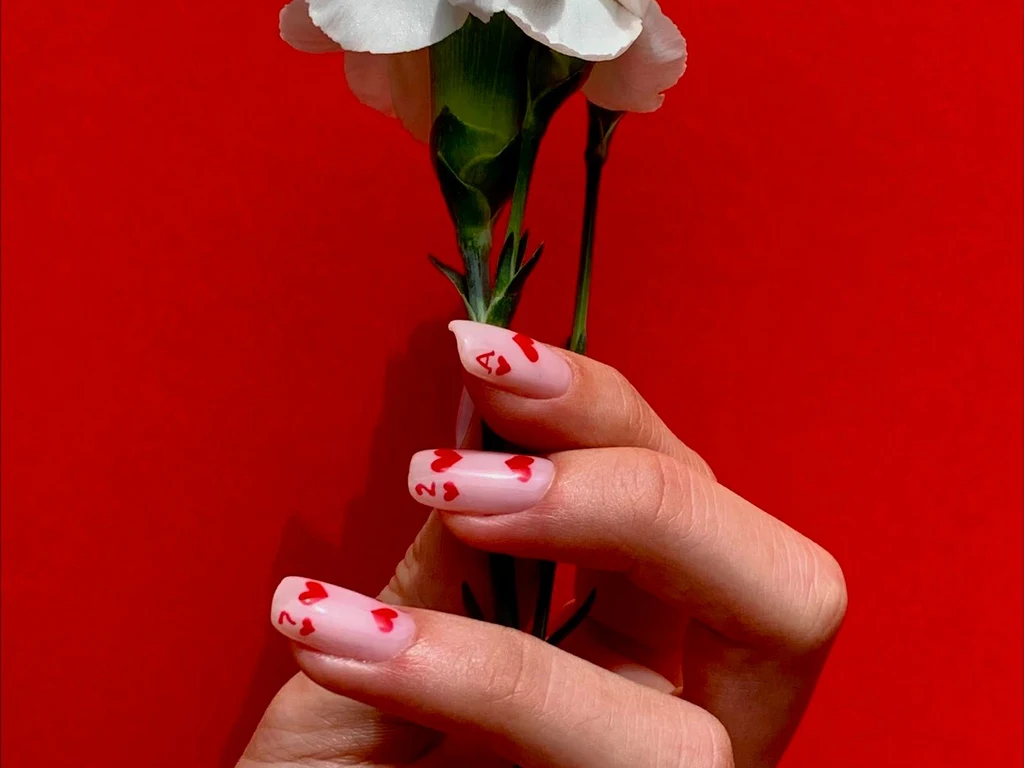
White nails with tiny red flower accents, the hand holding a white carnation against a red backdrop. The lesson in this photograph is scale against confidence: the base is bold and graphic — clean white, red all around — yet the flowers themselves are tiny, and the contrast between the big colour story and the micro art is exactly what makes the set look designed. On a French tip, this is a white smile line with one cluster of tiny red blooms at its corner. Red flowers are the highest-contrast floral there is; a little genuinely goes across the room.
Best for: bold dressers, red lovers and tiny-art confidence.
Salon tip: tiny red flowers are dotting-tool work — five small dots and a darker centre. Have each flower cured before the next begins; red gel bleeds into white bases faster than any other colour if it sits wet.
3. White Floral Nail Art with Lilacs
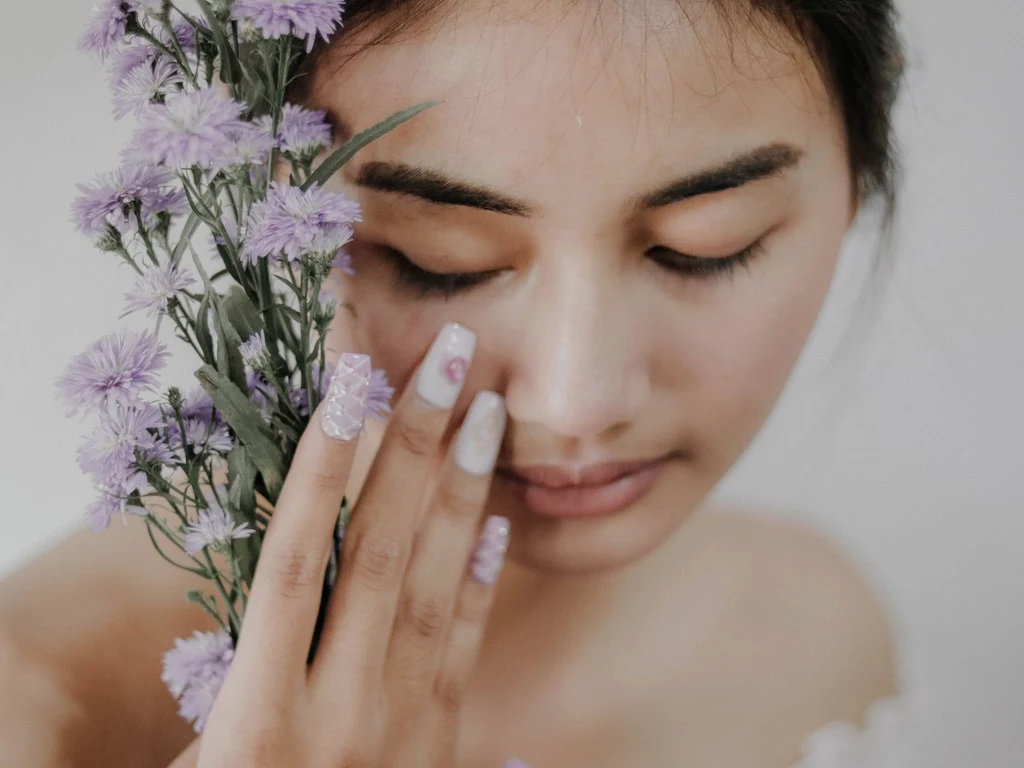
A soft portrait with white floral nail art, styled with lilac blossoms. White-on-white is the quietest floral technique in this guide: the flowers appear through texture and shadow rather than colour, visible where matte or satin petals catch light differently from a glossy base — the design people lean in to see. The lilac styling points at its natural partner: wear white florals with one pastel anywhere else in the set — a single lilac accent nail, a lilac tip — and the tone-on-tone art gains a frame. On a French manicure this is the bridal register of floral: present, photographic, and impossible to clash with a dress.
Best for: brides, tone-on-tone dressers and soft portrait styling.
Salon tip: white-on-white art needs a finish contrast to survive daylight. Matte flowers over a gloss base (or the reverse) is what keeps the design visible past the salon door.
4. Pastel Nails with Baby’s Breath Styling
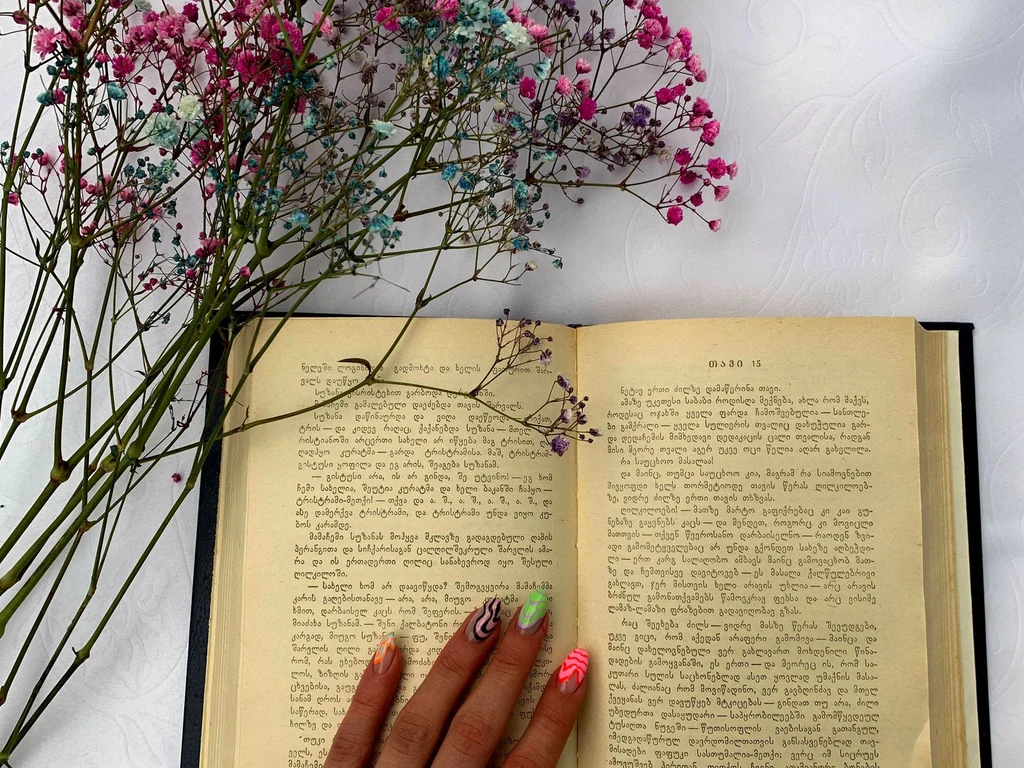
Multicolour pastel nails resting on an open book beside baby’s breath flowers — an honest styling photograph. The flowers here are beside the manicure, not on it, and the picture’s job is the palette: soft mixed pastels are the base colour story that baby’s-breath florals belong to. The wearable floral version is one of this guide’s prettiest small ideas — tiny white sprigs painted or pressed onto a pastel or sheer base, at the scale of the real flower, which is nature’s most delicate filler bloom. Worn over a soft glowing gradient it joins the family in our aura nails design ideas, where colour melts instead of stopping at lines.
Best for: pastel lovers, bookish styling and the softest floral entry.
Salon tip: baby’s breath is a sprig, not a bloom — paint it as a thin stem with three to five pinhead dots along it. One big white flower “inspired by” baby’s breath misses the entire point of the flower.
5. Blue Nails with a Pink Peony
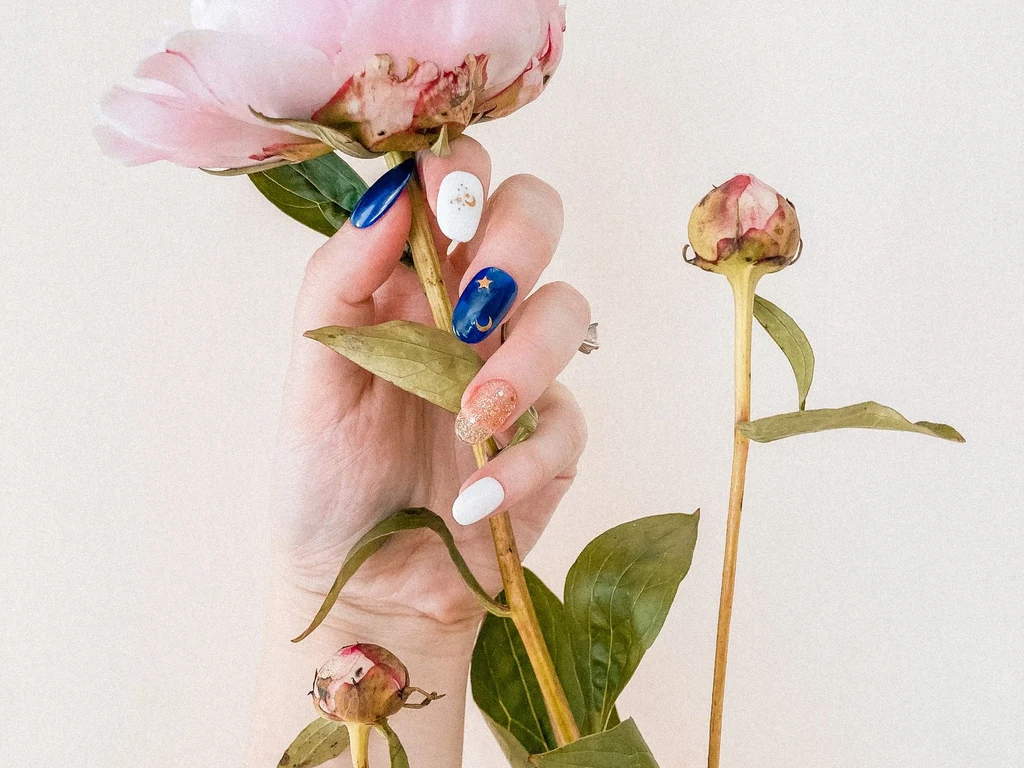
A hand with blue nails gently holding a pink peony bloom — the colour-story photograph of the list. Blue and pink is floral nail art’s most reliable pairing: cool base, warm bloom, each making the other look more itself. The peony in the hand is doing the teaching — its layered, ruffled petals are the shape to copy when a peony is painted onto an accent nail, and its exact pink is the shade to match. As a full design: blue nails (or blue French tips) with one painted peony on the ring finger, built from layered petal strokes rather than an outline, because a peony is all softness and no edges.
Best for: choosing a palette, blue lovers and peony devotees.
Salon tip: bring the flower, or its photo, to the appointment. “Peony pink” in a polish catalogue is a guess; the bloom in your hand is a specification, and a good artist will mix to it.
6. Light Blue Floral Art Nails with Roses
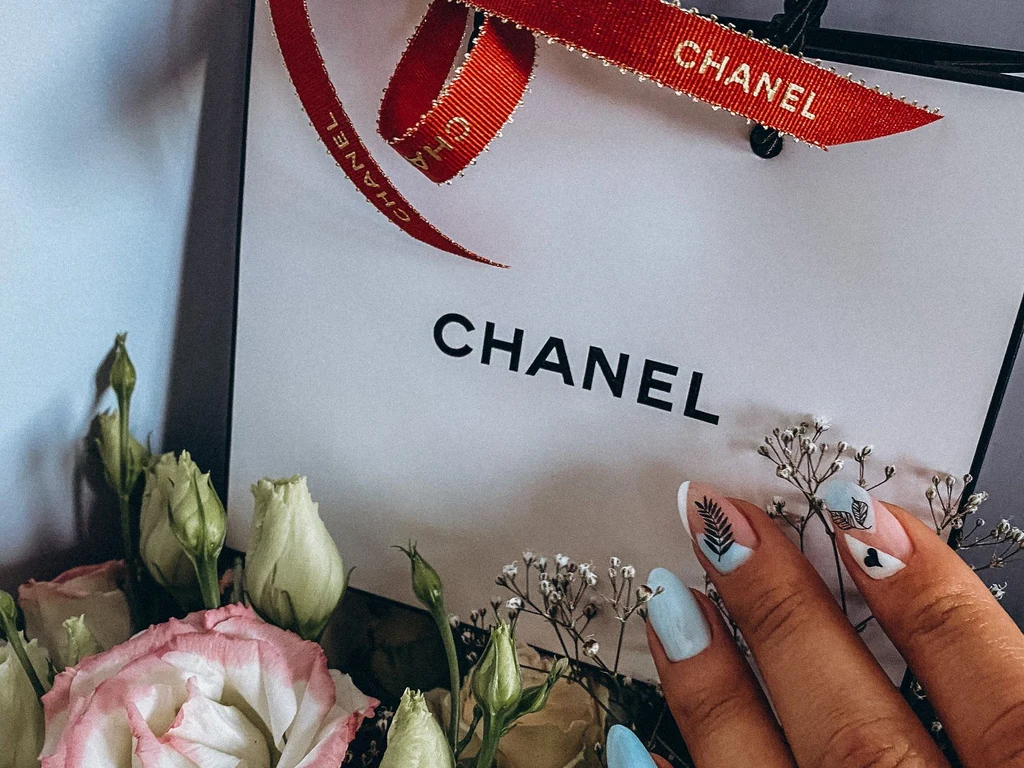
Light blue nails with white art, styled with roses — the reverse painting trick: light art on a coloured base instead of colour on a light one. White floral art over blue reads like porcelain or fine china, and it is more forgiving than it looks, because white gel over a mid-tone base covers in one confident stroke where a dark colour would need two. The roses in the styling supply the motif’s shape; on the nails themselves the white work stays small and scattered, which is the correct instinct — over a coloured base, floral art should be lace, not wallpaper. A blue French tip with white flowers along the smile line is this photograph’s direct French translation.
Best for: blue sets, porcelain lovers and white-art beginners.
Salon tip: white art gel must be highly pigmented — the chalky, translucent whites used for French tips streak when drawn thin. Ask for the art gel, not the tip gel, for any line work.
7. Mint Nails with Pink Blossom
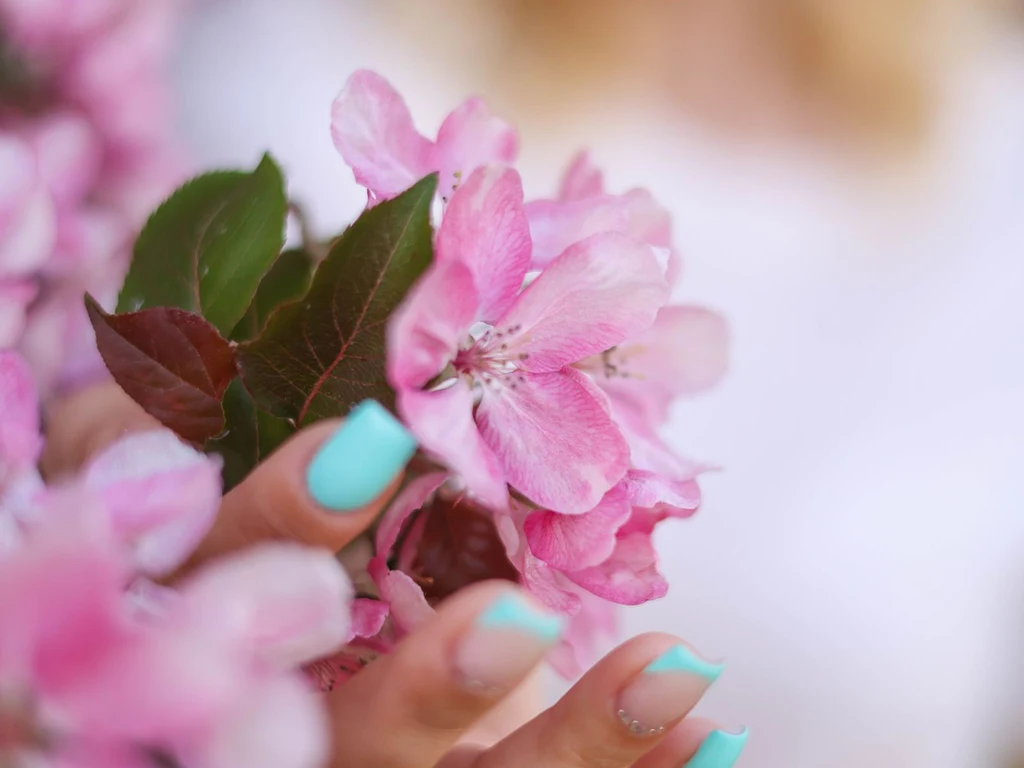
Mint-green nails touching soft pink cherry blossom — a colour pairing photographed at its source. Mint and blossom pink are complementary in the gentle register: the green cools the pink, the pink warms the green, and together they are the exact palette of design 21’s cherry blossom French. Use this photograph the way design 5’s peony is used — as the palette agreement before painting starts. Mint is also a kind base for floral art: pale enough for pink petals to read clearly, coloured enough that a French version (mint tips, blossom on the accent) looks designed rather than decorated.
Best for: mint lovers, blossom palettes and gentle contrast.
Salon tip: mint bases can make pink art look slightly peach by contrast. If true blossom pink is the goal, choose the petal shade one step cooler — more blue-pink — than the bottle suggests.
8. Pink Nails with a Daisy
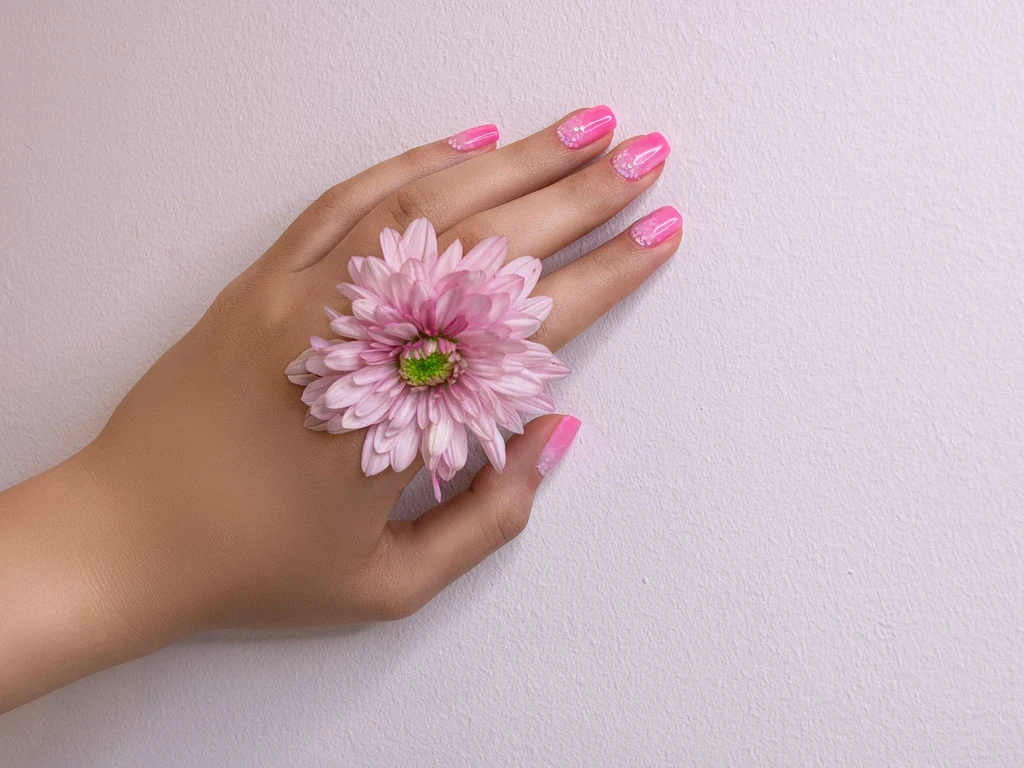
Pink polished nails with a pink daisy resting on the hand — the friendliest flower in the guide, shown at its real scale against a real manicure. The daisy is floral nail art’s first word: five or six petals around a centre, drawable with a dotting tool by a complete beginner, and readable at any size from a pinhead to a whole nail. The styling here makes the scale point — one daisy, resting on the hand, is enough of a statement. Copied onto nails, that becomes one daisy per accent nail in a matching pink, over this same pink base or a pink French tip (design 14 is the white version of the idea).
Best for: first-ever floral art, daisy lovers and DIY sets.
Salon tip: a daisy’s centre dot goes on last and slightly raised — a tiny dome of yellow or gold gel. That one dot of dimension is what separates a daisy from a white blob with ambition.
9. Classic French Manicures with White Roses
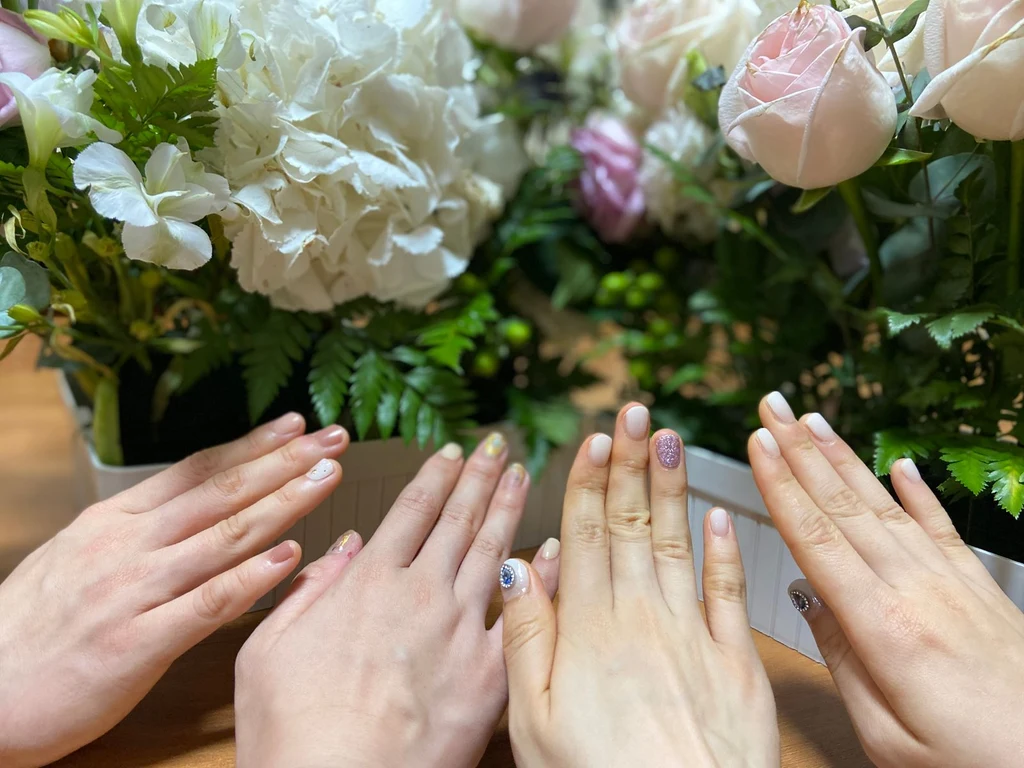
A group of hands with fresh French manicures arranged under white roses and greenery — the canvas itself, photographed. There is no floral art on these nails, and that is the honest point: every design in the second half of this list starts as exactly this — a clean, classic French — and the flowers are added to it. The group styling shows the other truth: a plain French is the one manicure a whole bridal party, office or family can wear together without a single clash, and one floral accent nail per person (design 17) individualises it without breaking the photograph. Study the smile lines here; floral art deserves a base this clean.
Best for: bridal parties, group bookings and French purists.
Salon tip: when a group books together, book the plainest French for everyone and let each person add one personal accent — a flower, a dot, a pearl. Uniformity plus one difference photographs better than five different sets.
10. Pink-Tipped Nails on an Open Book
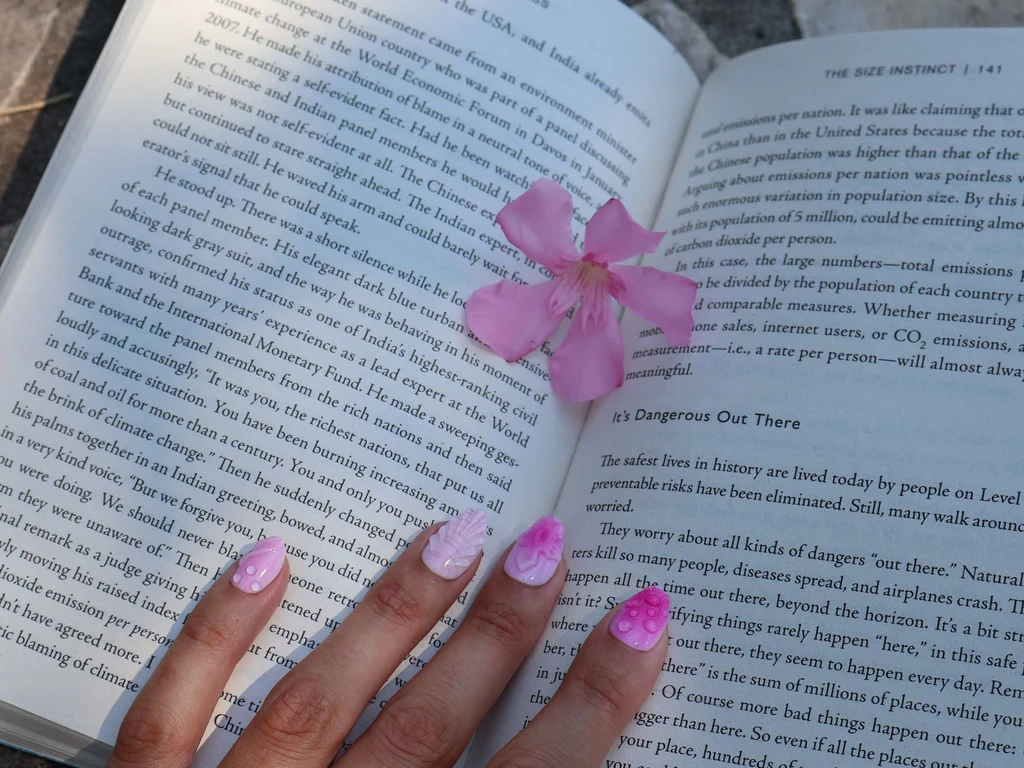
A hand with pink-tipped nails resting on an open book, a pink flower alongside — the coloured French tip in its natural habitat. A pink tip instead of white is the gentlest possible modernisation of the French manicure: the structure stays classic, the mood turns warmer, and a single real flower in the frame shows how little it takes to suggest the floral version — tiny pink blooms along one smile line, or a flower accent on the ring finger, in the same pink family as the tips. This is the everyday end of floral French design: a manicure that reads “pink French” from across the room and “flowers” only up close.
Best for: coloured-tip lovers, quiet styling and everyday floral hints.
Salon tip: match the flower art to the tip colour’s family, not its exact shade — petals one step lighter or deeper than the tip read as shading; an exact match reads as a printing error.
11. Black French Tips Among Green Leaves
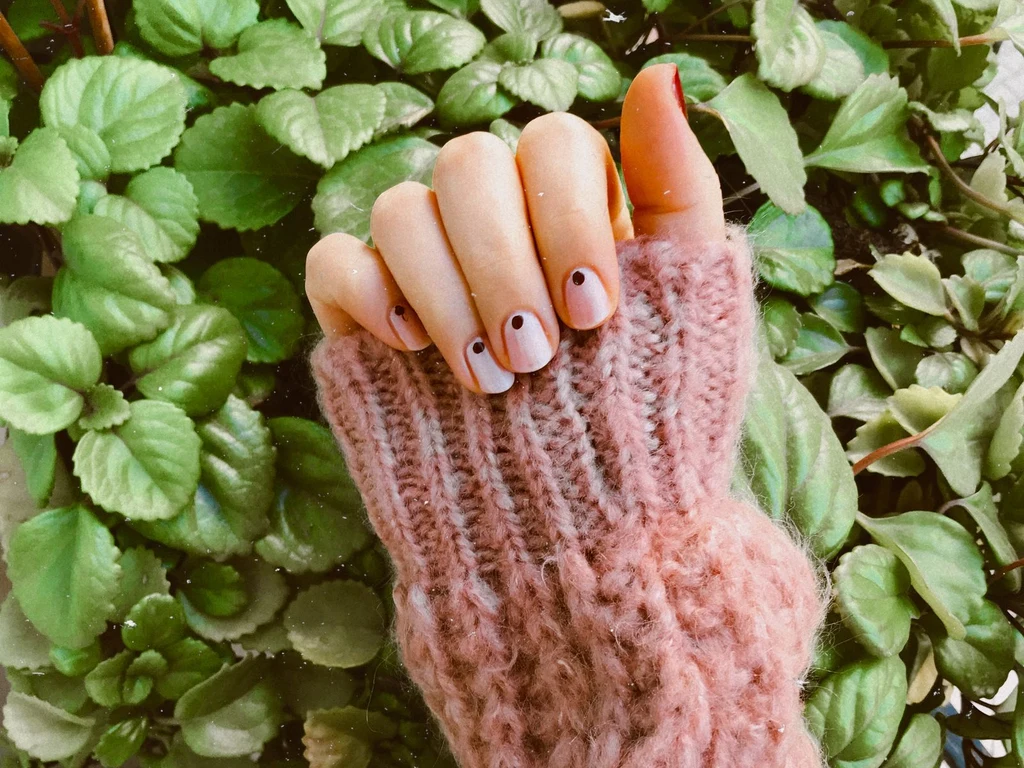
Black French tip nails with tiny white details, the hand in a pink knit holding green foliage. A black French is already a statement — the smile line turned to ink — and the tiny white details on it are micro-florals in waiting: at this scale, a five-dot white flower and a decorative dot are nearly the same gesture, which is exactly why black tips are such a good floral base. The white pops at maximum contrast, so the flowers can stay pinhead-small and still be the whole design. The green foliage in the styling is the colour note: black, white and one green is the garden at midnight, in three colours.
Best for: dark-French lovers, micro detail and high-contrast minimalism.
Salon tip: on black, cure each tiny white flower fully before moving on. White gel dragged across a black base leaves grey ghosts that cannot be wiped away once cured.
12. Black Nails Holding a White Rose
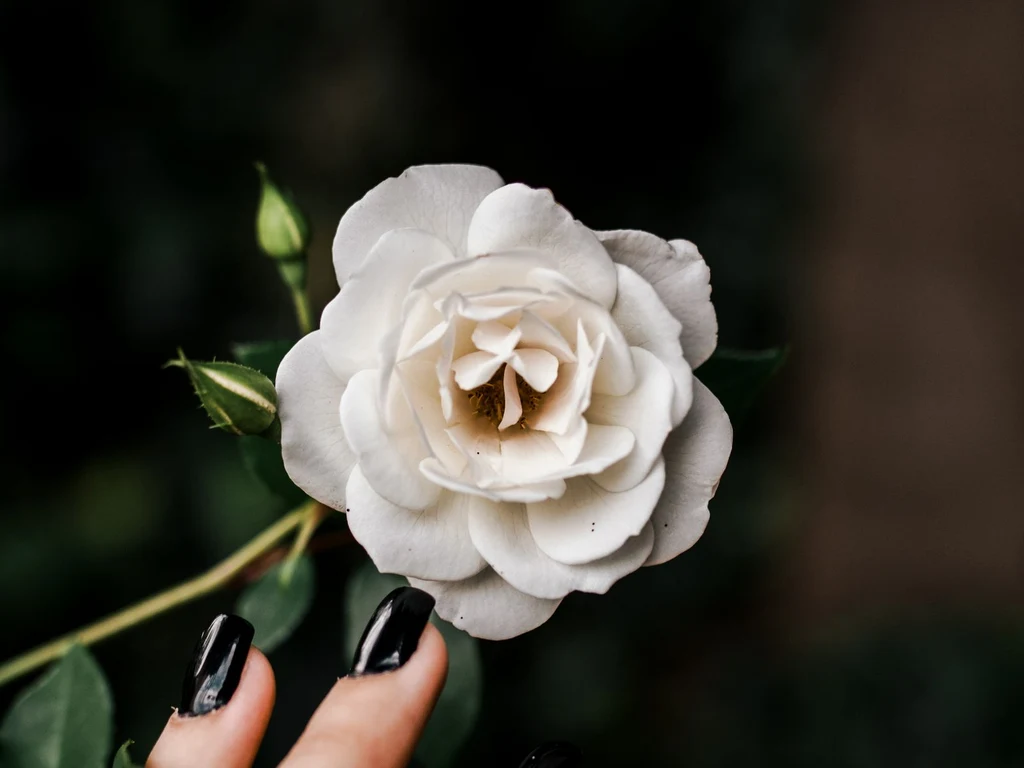
A hand with black polished nails holding a single white rose — the contrast photograph of the guide. No art is on these nails either; the picture is the colour brief for the boldest floral family in nail art, white flowers on black. A white rose painted on a black accent nail (or a black French tip, as in design 11) borrows all of this photograph’s drama: the bloom glows because the ground is darkness. It is also the honest limit of the idea — white floral art needs a dark stage or a very steady hand with shading, because white on a pale French base is design 3’s whisper, a completely different manicure.
Best for: drama lovers, evening sets and white-rose devotees.
Salon tip: a painted white rose on black needs one grey shadow layer under the white petals, or it reads as a flat sticker shape. The shadow is two brush strokes; skip it and the rose loses its roundness.
13. Black Nails with White Roses
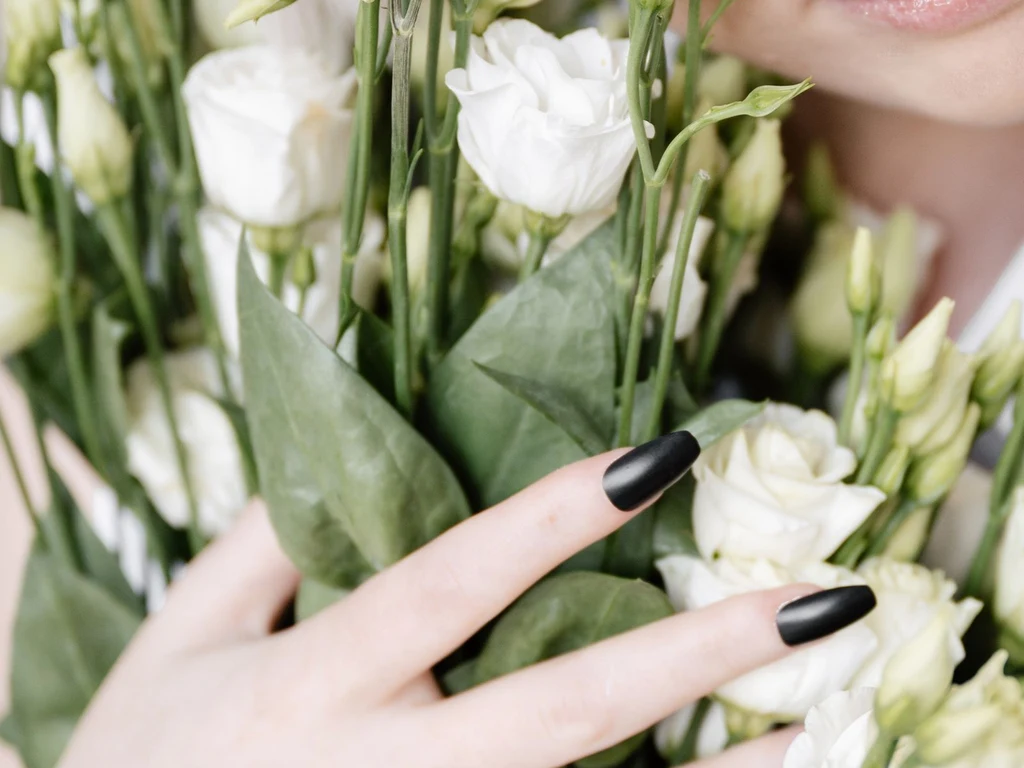
Black nails holding a whole bouquet of white roses — design 12’s idea at full scale. Where one rose is a portrait, a bouquet is a garden, and the manicure translation follows the same rule: one white rose is an accent nail; a scatter of smaller white blooms and buds across black nails is a full floral set. The bouquet also teaches the supporting cast — buds and half-open flowers among the full blooms are what make a floral arrangement (and a floral manicure) look grown rather than pasted. On black French tips, keep the biggest bloom on the ring finger and let buds travel onto its neighbours.
Best for: full black floral sets, formal evenings and rose gardens in miniature.
Salon tip: vary the bloom sizes deliberately — one large, two medium, a few buds. Identical roses in a row read as a print; a size gradient reads as a bouquet, on nails exactly as in a vase.
14. White Daisy French Tips
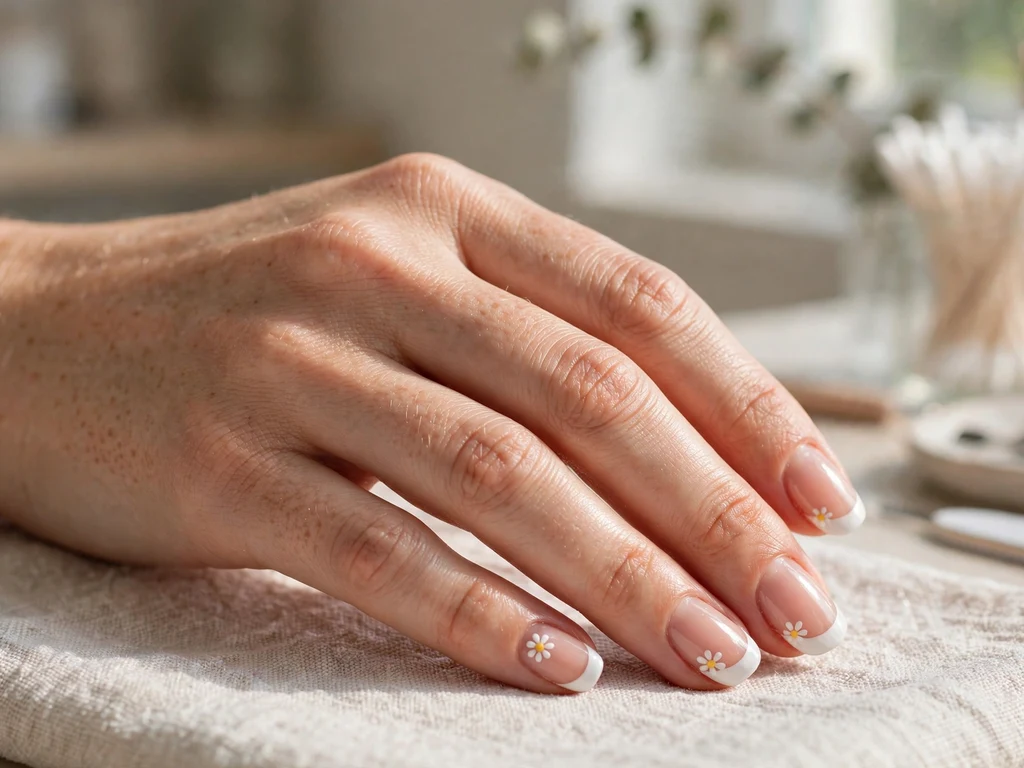
French tips with tiny white daisy accents painted at the tips — the classic floral French, and the design this guide would save if it could save only one. The daisy is built from the simplest unit in nail art: five white dots around a yellow centre, made with a dotting tool in under a minute per flower, placed right where the smile line gives it a frame. It is the same daisy-along-the-smile-line idea our late spring French tip nails collection uses in its garden set — proof the design belongs to every season, not just one. Two or three daisies per hand is the classic count; a full daisy chain along every tip is the festival version.
Best for: the definitive floral French, beginners and garden parties.
Salon tip: daisies sit best just behind the smile line, on the base side — on the white tip itself they vanish. Petals need a background that is not their own colour.
15. Hand-Painted Rose French Tips
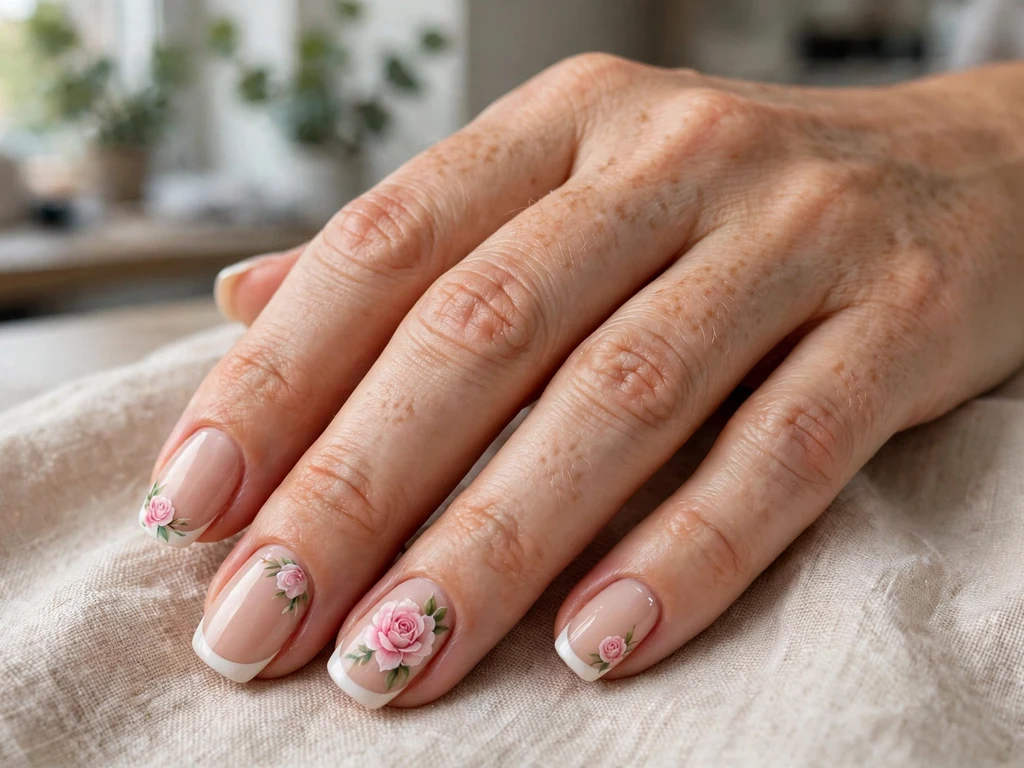
Nude French tips with hand-painted pink roses — the craft summit of the painted family. A painted rose is not drawn; it is built, from a tight centre swirl outward in comma-shaped strokes, each petal a single loaded-brush gesture, so no two roses on the hand are identical and the set reads as grown rather than printed. Pink is the rose’s home colour, and the full pink family — including a pink French with floral details — lives in our pink French tip nails collection; this is its hand-painted, garden-grown member. Book it with time: a good rose takes minutes each, and rushing shows.
Best for: romantics, weddings and anyone choosing the painted route at its best.
Salon tip: judge a rose artist by their centres. Petals can be forgiven; a muddy, overworked centre cannot. Ask to see one cured test rose on a tip before the set begins.
16. Tiny Flowers on Milky French Tips
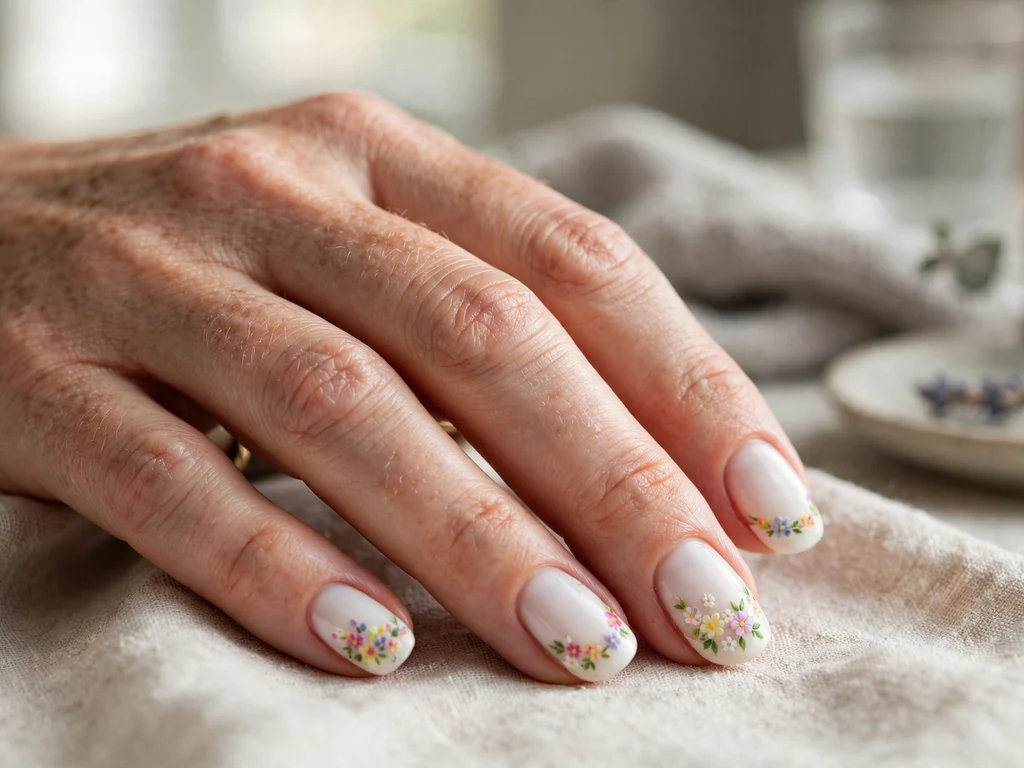
Milky white French tips sprinkled with tiny multicolour flowers — a meadow, miniaturised. The milky base is doing quiet work here: its soft cloudiness blurs the border between base and tip, so the tiny flowers seem to float in mist rather than sit on a line. The flowers themselves are the smallest unit that still reads as a flower — a dot of colour for petals, a pinhead centre — scattered with the random, uneven placement Allure’s artist recommends, denser near the tips and thinning toward the cuticle. Decals do this design fastest; a steady hand with a dotting tool does it most personally.
Best for: meadow lovers, milky-base fans and tiny-art collectors.
Salon tip: scatter means scatter — plan three cluster zones per nail, not a grid. Flowers placed at measured intervals read as polka dots that happen to have centres.
17. Floral Accent Ring Finger French
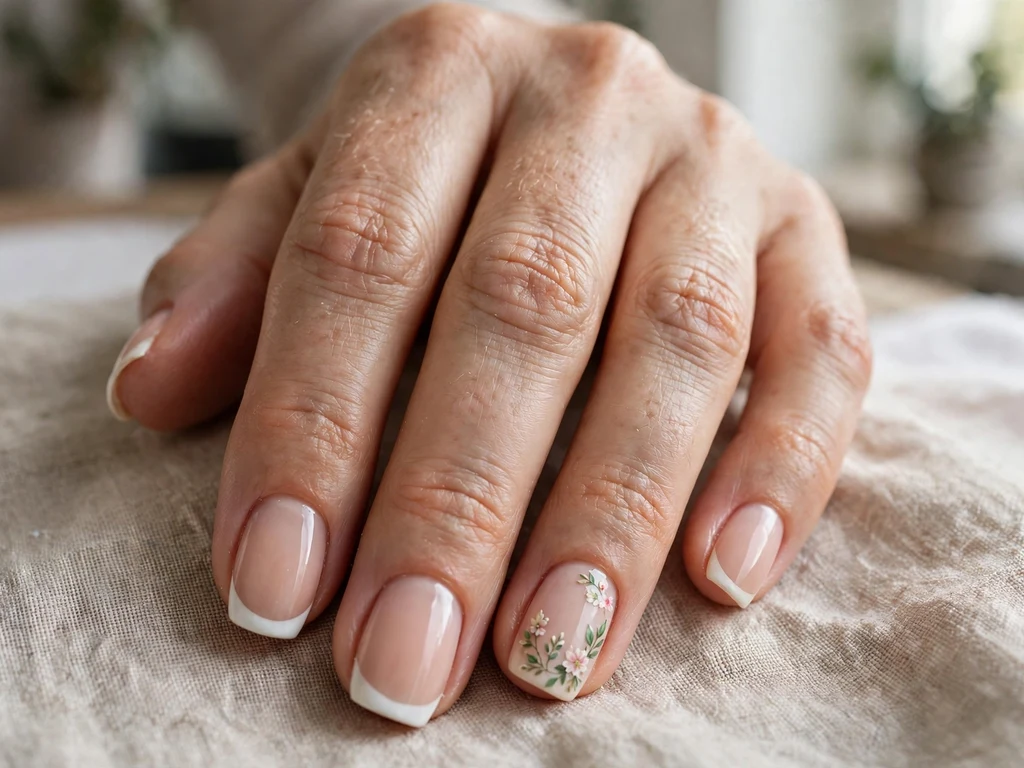
Nude French tips with floral art on the ring finger only — the one-nail rule, stated as a whole design. Nine nails stay clean, classic and beyond criticism; one nail carries a small garden. This is the highest-worn floral design in real life because it solves every problem at once: the event photograph has its flower (on the finger that holds the ring and appears in every held-hand picture), the office sees a plain French, and the wear cost is one nail’s worth of care. It is also the cheapest way to buy the best work — one nail of a master artist’s roses costs less than ten nails of anyone’s.
Best for: weddings, first floral sets and the strategically minded.
Salon tip: let the accent nail’s flowers borrow one colour from nothing else you are wearing — a flower that matches nothing reads as a brooch: deliberate, separate, jewellery-like.
18. Sunflower French Tips
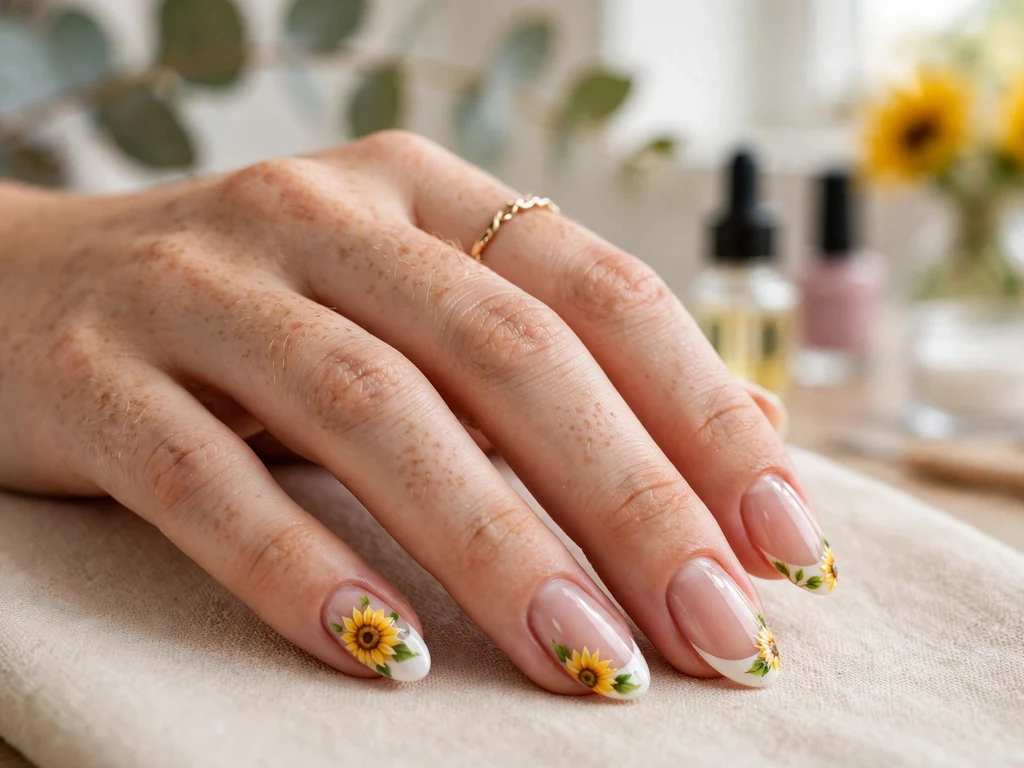
French tips with cheerful sunflower art — the happiest design in the guide, and the one with a whole fan club. The sunflower is the rare big flower that simplifies well: a dark brown centre and a ring of yellow petals read as “sunflower” even at thumbnail scale, which is why it survives translation onto a French tip where a rose would crowd. Byrdie’s sunflower manicure roundup makes the same case from every angle — sunflower French tips, sunflowers fitted onto short nails, even dried sunflower “milk bath” versions — proof the motif bends to any technique. On a French base, one sunflower per accent nail is the classic; petals spilling over the smile line is the playful version.
Best for: pure cheerfulness, summer sets and sunflower devotees.
Salon tip: two yellows, not one — petals in a lighter yellow with a deeper golden shadow at their bases are what give a flat dot-flower its sunflower depth. A single yellow reads as a daisy that changed teams.
19. Lavender Floral French Tips
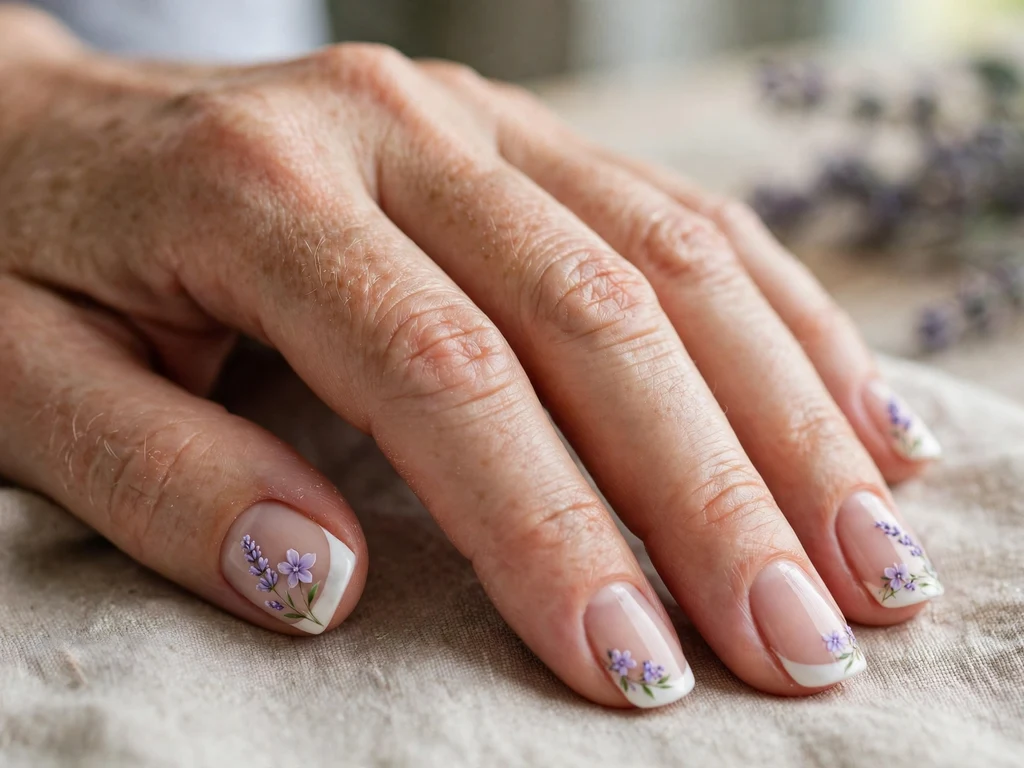
French tips with delicate lavender-purple flower art — the soft purple register of the garden. Lavender the flower is itself a sprig of tiny blooms, which makes it the most forgiving detailed flower to paint: a fine stem with small purple dots clustered along it is honestly how the plant looks. On a French tip the pairing is gentle on gentle — pale purple art on a sheer base with a white edge — and it stays grown-up as long as the purple leans dusty rather than candy. Wear it with the lilac styling of design 3’s portrait and the two ends of the purple family agree with each other.
Best for: purple lovers, soft gardens and dusty-palette dressers.
Salon tip: lavender art reads grey if the purple is too blue. Warm it half a step toward pink and it stays floral; test the cured dot beside the white tip before the set.
20. Pressed Flower Clear Nails
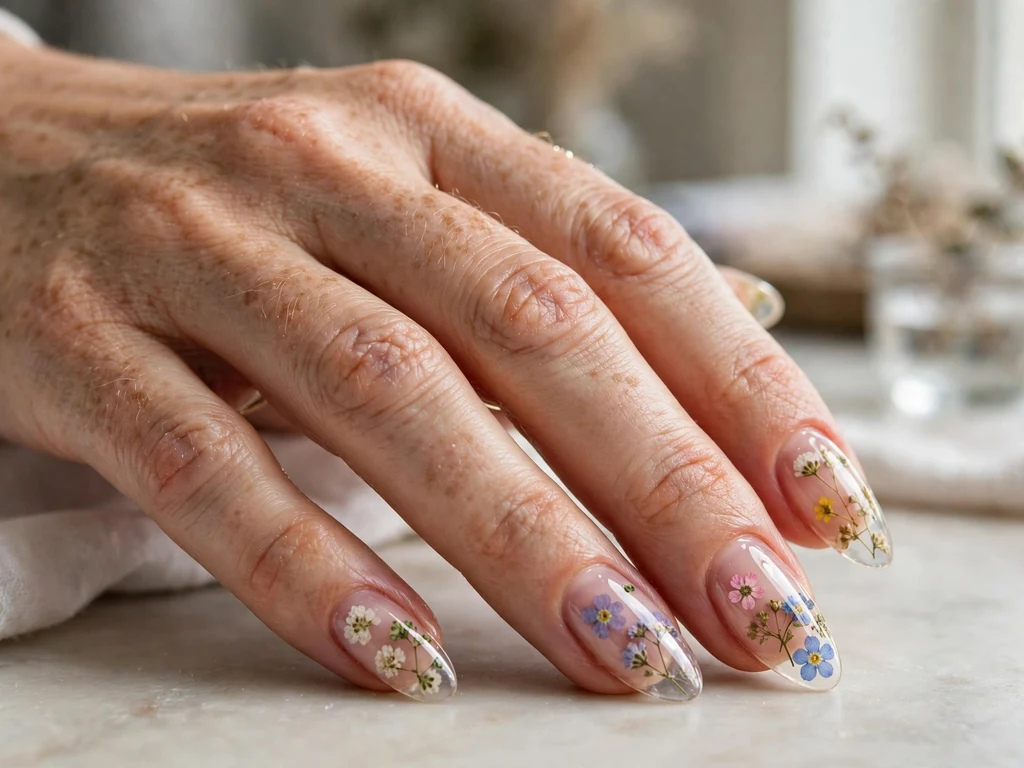
Clear glossy nails with tiny pressed-look flowers sealed inside — the only design in this guide where the flowers are (or appear to be) real. Real dried micro-flowers, placed on the tacky base and buried under clear gel, float inside the nail like specimens in glass: real petals, real depth, nothing painted and nothing protruding. It is the “milk bath” family at its clearest — swap the clear gel for a milky one and the same flowers drift in fog instead. The honesty rules are strict: only properly dried, flat flowers survive encapsulation, and the seal must be total, because a real petal at the surface will lift, brown and take the design with it.
Best for: nature lovers, specimen beauty and conversation-starting sets.
Salon tip: dried flowers are fragile and slightly three-dimensional — press each one into the tacky layer and let the first clear coat be generous. Skimpy gel leaves a petal tip at the surface, and that tip is where the set will fail.
21. Cherry Blossom French Tips
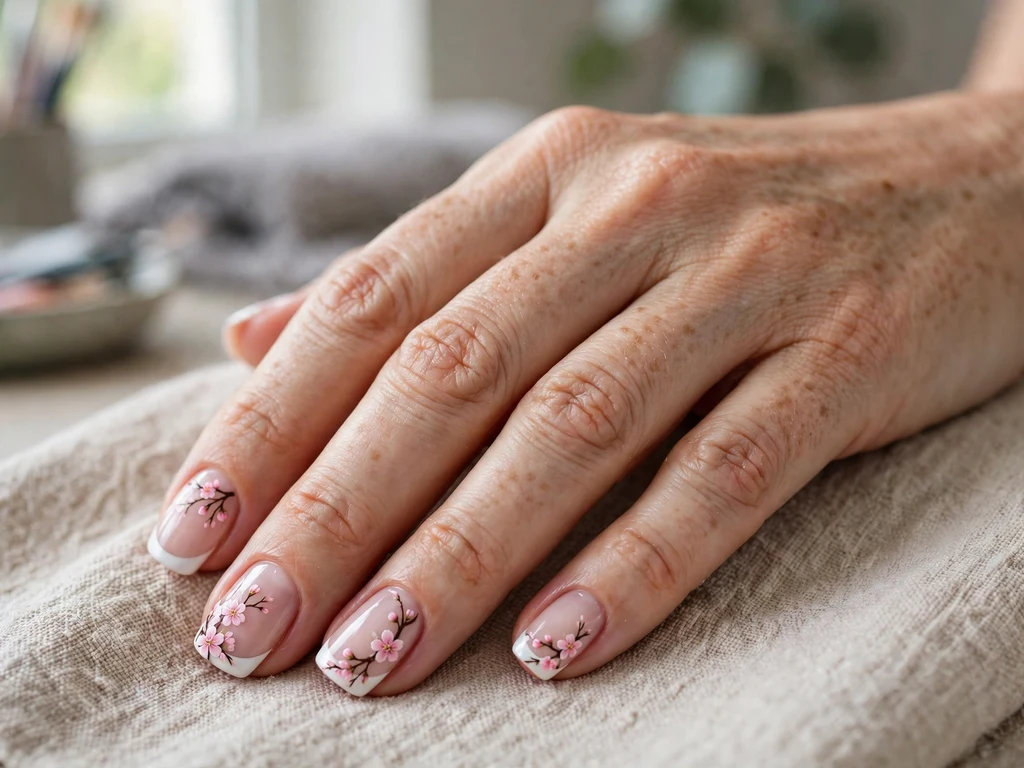
Pink French-style nails with cherry blossom art — the branch is the design. Where most florals are single blooms, cherry blossom is painted as a dark, wandering branch line with five-petal pink flowers opening along it, and that branch is what makes it read as blossom rather than generic pink flowers: the flowers have somewhere to grow from. The palette is the one photographed in design 7 — blossom pink against a cool ground — here kept in the pink family on a French base. Blossom season is short, but the manicure is not: this is one of the few floral designs that is genuinely evergreen, worn in every month by people who simply love it.
Best for: blossom lovers, branch-and-bloom art and pink French fans.
Salon tip: draw the branch first, fully, and cure it before any petal is placed. Flowers painted before the branch wander — the eye needs the branch to organise them, and so does the brush.
22. Floral French Tips on Short Square Nails
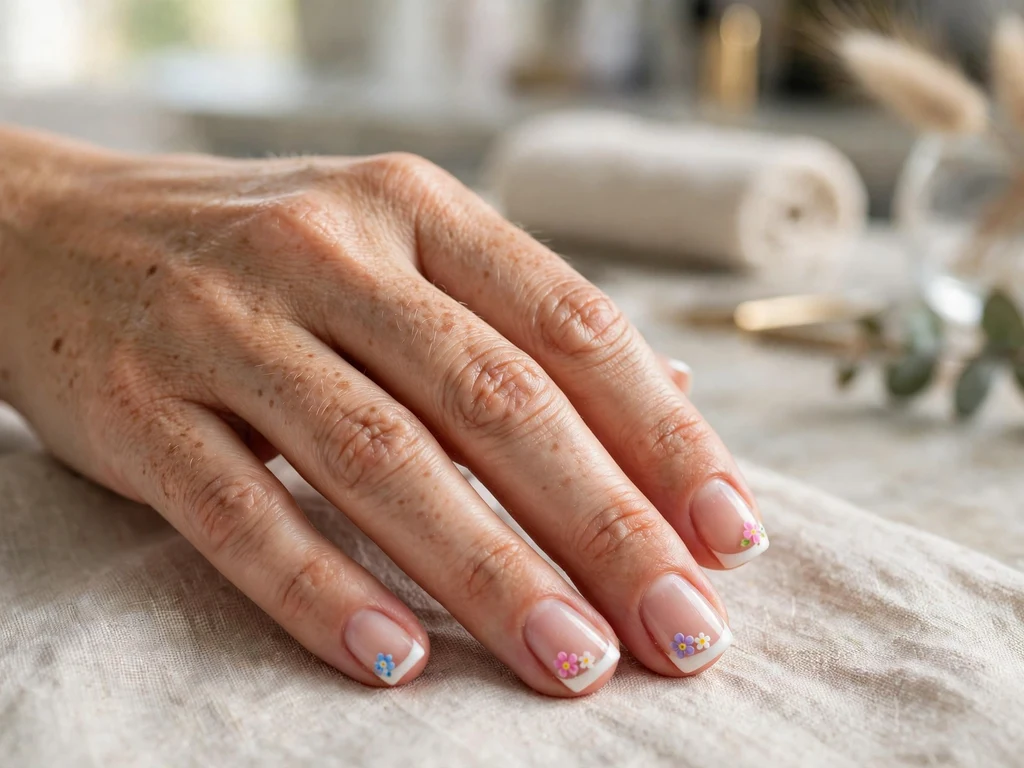
Short square French tips with a tiny flower detail — the everyday proof that floral art does not need length. The rule for short nails is scale honesty: one tiny flower, placed at a corner of the tip or on one accent nail, at the size the nail can honestly hold. A full bouquet compressed onto a short square nail loses its petals and reads as a smudge; a single five-dot daisy stays crisp for the set’s whole life. Short nails also protect art better than any other length — less leverage, fewer knocks — so this small design routinely outlasts the big romantic sets in this list.
Best for: short nails, busy hands and everyday floral wear.
Salon tip: on a square nail, place the flower off-centre, toward one corner of the smile line. Centred art on a square nail reads as a logo; corner art reads as a garden escaping its frame.
23. Autumn Floral Styling Nails
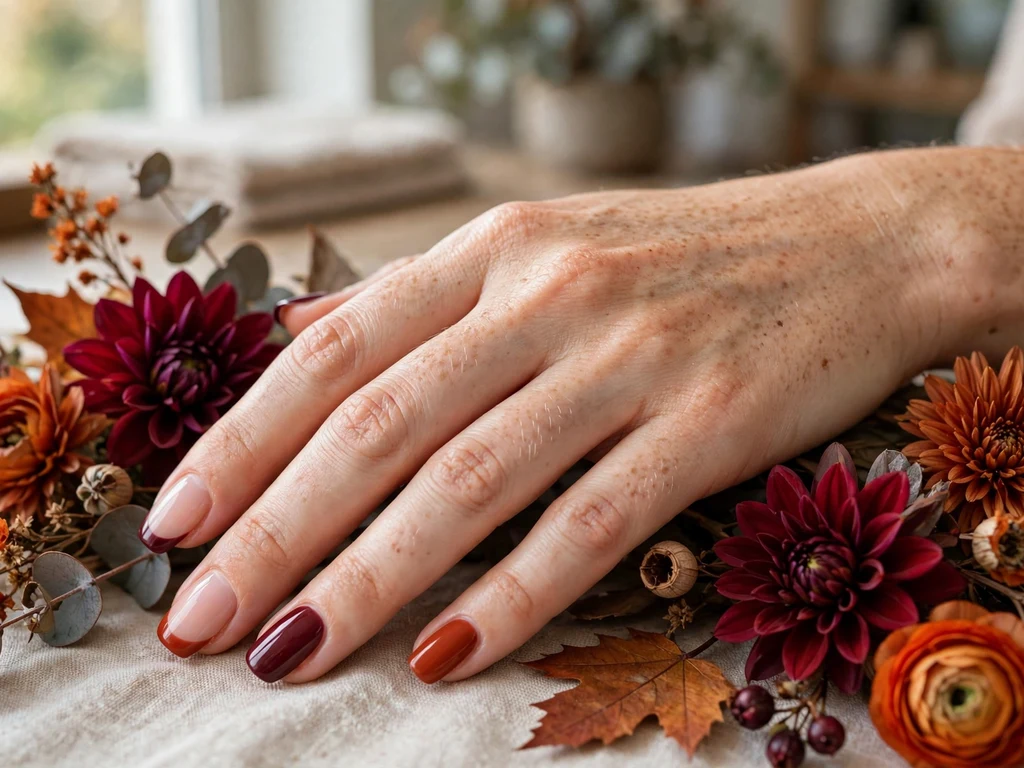
Burgundy and rust-toned nails styled with an autumn flower arrangement — and the honesty matters here: the flowers in this photograph are in the styling, arranged beside the manicure, not painted on the nails. What the picture actually sells is the palette. Burgundy and rust are where the floral family goes when the light turns: the same flowers, in deeper colours — rust roses, burgundy dahlias, dried-look blooms — painted on an accent nail over this exact base. Use the arrangement as the colour brief, exactly as designs 5 and 7 use their blooms, and the set becomes the autumn member of the floral family: rich, warm and a little dried-flower in spirit.
Best for: autumn palettes, burgundy lovers and rich, warm sets.
Salon tip: autumn florals need one dried-looking element — a matte petal, a brown-edged bloom, a pressed flower from design 20’s family. All-gloss rust florals read as summer flowers wearing the wrong colours.
24. Tropical Hibiscus French Tips
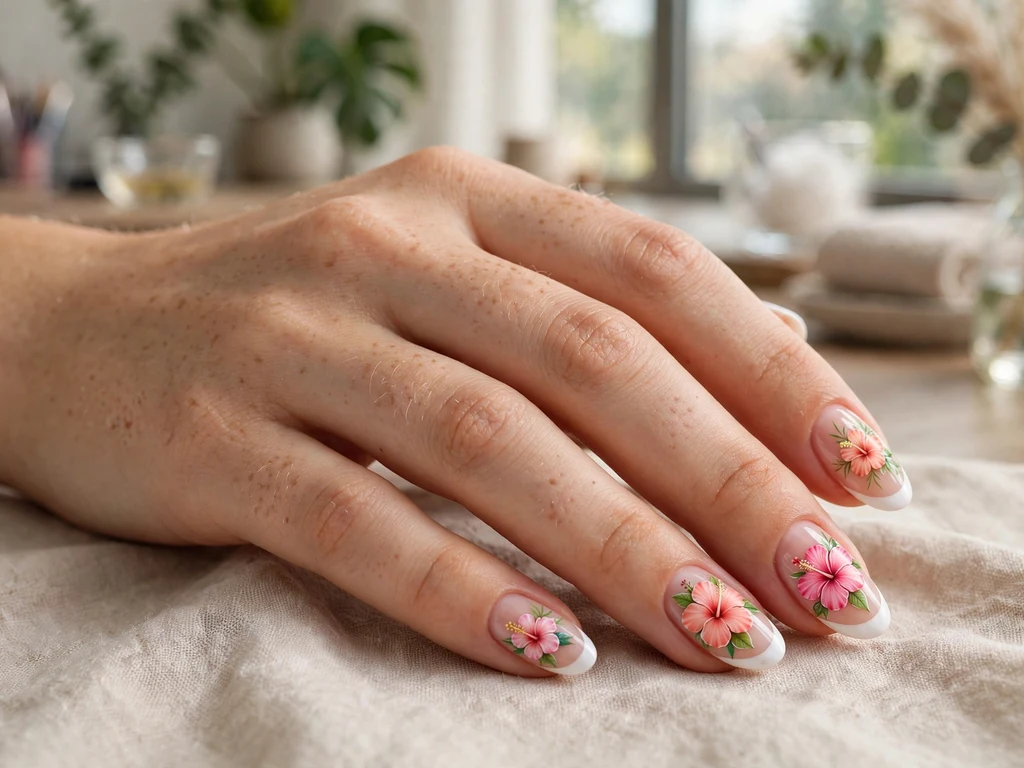
French tips with pink hibiscus-style floral art — the biggest flower in the guide, worn at vacation scale. The hibiscus is five large petals and a long stamen, a flower with no interest in being subtle, and the French base is what keeps it elegant: all that tropical colour is confined to the art while the smile line and sheer base keep the structure classic. One hibiscus per hand is the salon standard; the flower is large enough that two per nail becomes a print. Pink is the classic, but the same shape in coral or white over a coloured tip travels just as well.
Best for: vacations, summer sets and big-flower confidence.
Salon tip: the stamen makes the hibiscus — a thin curved line with a dot cluster at its end, drawn after the petals are cured. Without it, five pink petals read as a generic flower; with it, the flower has a name.
25. Floral French Tips with Gold Foil
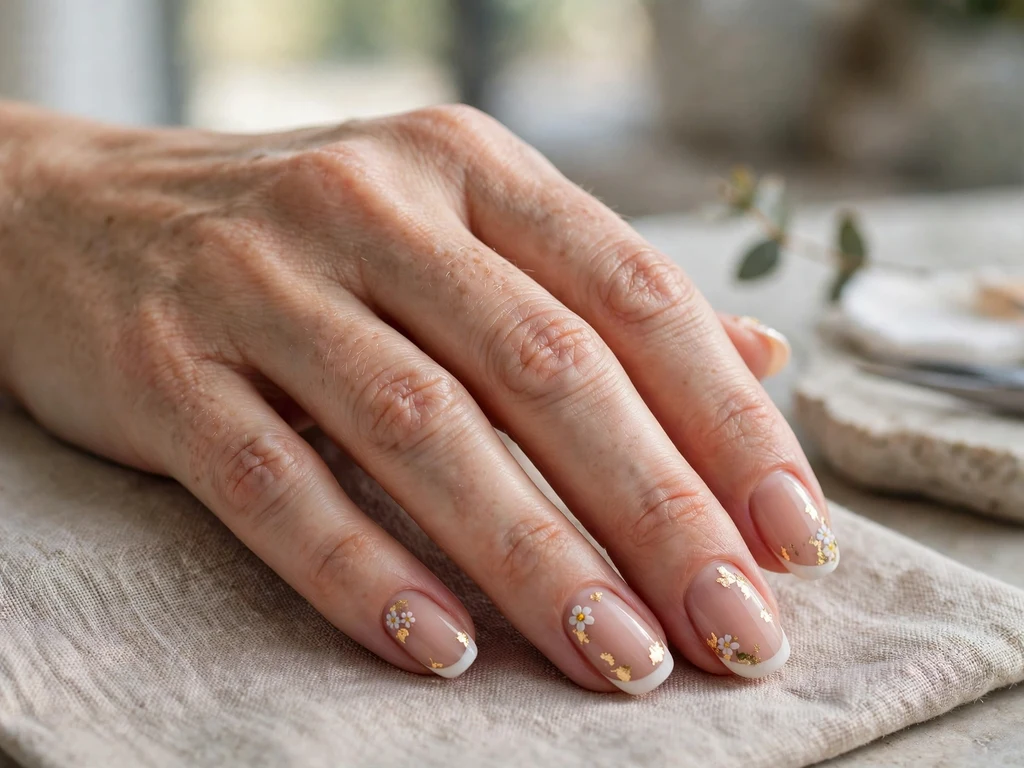
Nude French tips with tiny flowers and gold foil accents — the understated-luxury ending. Foil changes the temperature of a floral set completely: the flowers stay small and soft, and irregular gold fragments scattered among them catch light like something gilded rather than painted. Because the foil is torn, not drawn, no two nails match, and here that reads as hand-made rather than untidy — the same licence design 15’s painted roses enjoy. Keep both elements on the accent nails or along the smile lines, and the set stays a French manicure that happens to contain a tiny, gilded garden.
Best for: understated luxury, gold-jewellery wearers and soft-glam evenings.
Salon tip: foil goes on in small torn pieces onto the tacky layer, sealed edge-to-edge — and flowers are painted after the foil is sealed, never under it, or the petals inherit every wrinkle the foil makes.
How to Choose Your Floral Design: Flower, Technique and How Busy
Most floral disappointment is not about the flowers — it is about the match between the technique’s honesty and the wearer’s week, and between the flower’s scale and the nail that carries it. Use this table first, then the key points below it.
| Your style / occasion | Technique & scale that suit you | Designs to start with |
|---|---|---|
| Everyday / office | Tiny painted flowers or decals, one or two nails | 17, 22, 14 |
| First floral set ever | Dotting-tool daisies or decals | 14, 8, 16 |
| Weddings & formals | White tone-on-tone, one painted rose accent | 3, 9, 15, 17 |
| Garden parties & photos | Painted blooms, colour stories, a full garden | 1, 5, 15, 21 |
| Short nails, busy hands | One tiny flower, corner-placed | 22, 14, 16 |
| Vacations & summer | Hibiscus, sunflowers, bold colour | 24, 18, 2 |
| DIY at home | Dot flowers first, decals second, pressed kits third | 14, 16, 20 |
Key points for choosing well:
- Scale is the design. One bloom on one nail (17) is jewellery. A sprinkle across all ten (16) is a meadow. Flowers at full size on every nail (13, 24) is a pattern, and patterns are outfits — joyful, total, impossible to dress down. Decide which of the three manicures you actually want before discussing flowers.
- Match the technique to the truth about the artist. Hand-painted roses (15) are the summit and are priced and timed like it. Decals deliver identical, detailed flowers for a fraction of the cost and are the honest choice when the event matters more than the craft. There is no virtue ranking — there is only the set that survives your calendar.
- Choose the flower by its shape, not just its colour. Daisies and five-petal blossoms simplify beautifully and survive small sizes; roses and peonies need an accent nail’s full canvas; sprig flowers (lavender, baby’s breath, cherry blossom) need a branch or stem line to read as themselves. A flower squeezed below its honest size loses the feature that names it.
- Steal colour stories from real flowers. Blossom pink on mint (7), peony pink on blue (5), white roses on black (12, 13) all work because nature mixed them first. If you are inventing a palette, borrow the real structure: the bloom’s colour, its leaf green (used sparingly), and one neutral ground.
- One garden per set. Flowers plus one supporting texture — a foil fleck (25), a milky base (16), a gradient — is a design. Flowers plus gems plus glitter plus a second motif is a sample board. The exception that proves it: butterflies belong with flowers (they share a garden), and even they should visit one nail at a time.
- Occasion sets get booked close, everyday sets get built small. A sculpted or fully painted set for a wedding belongs one to two days before the event. An everyday floral should be flat, sealed and small — dot flowers, decals and minis are the three forms that ask nothing of your week.
How Floral Art Wears — and How to Protect It
A floral set wears like the product underneath it — two to three weeks in gel — but each technique has its own honest weak point, and they are worth knowing before you choose:
Key points for wear:
- Painted flowers are the surface — protect the gloss above them. Hand-painted blooms (1, 15, 21) are sealed under the top coat and last the set’s full life, but scratches fog fine petal work first. A thin top-coat refresh every four to five days keeps roses looking wet and new instead of gently dusty.
- Decals fail at the edges, never the middle. A decal lifts where its seal breaks — one exposed corner, one long hot soak on the first day. The defence is all at application: edges wrapped in top coat, free edge capped. Sealed properly, a decal flower outlasts most people’s expectations.
- Pressed flowers live or die by the seal. A real dried petal (20) is safe only while it is fully buried — if a tip reaches the surface it will lift, catch moisture and brown. If you can feel any texture over a pressed flower, it needs another clear layer, and that is a five-minute salon fix worth making in week one.
- Sculpted petals catch — plan the week, not just the look. Raised flowers share every weakness of raised art: hair-washing, knitwear and tights are their natural predators. Wear sculpted blooms on accent nails, base-half, for the days that justify them, and check the seat of each petal daily.
- Oil and gloves still run the show. Cuticle oil daily and gloves for wet work protect the base every one of these techniques stands on. Art grips a healthy, sealed nail; it slides off a dry, lifting one, whatever is painted on it.
Removal:
- Painted and decal flowers soak off with the set. File the gloss, wrap in acetone pads for 10 to 15 minutes, and let the layers soften away together. Decals sometimes release as tiny whole films partway through the soak — that is normal, and they should slide, never be peeled.
- Pressed flowers come out with the gel around them. The dried bloom is inside the enhancement, so removal is the standard file-and-soak — never dig a flower out of a cured set to keep it. It will not survive the rescue, and the nail plate underneath might not either.
- Sculpted flowers are soaked, never pried. A well-set petal is bonded into the gel beneath it; forcing it removes that layer and the nail surface under it. Soak until the gel softens and the piece releases on its own, then oil generously.
Frequently Asked Questions
What are floral nails?
Floral nails are manicures where a flower — a whole bloom, a cluster of petals, or a flowering sprig — is the nail art, most often placed on one or two accent nails or along the smile line of a clean base like a French tip. The flowers are made four ways: hand-painted with a brush or dotting tool, applied as decals or stickers, sealed into the nail as real dried flowers, or sculpted in 3D from gel or acrylic. The family ranges from a five-dot daisy anyone can make (design 14) to a hand-painted rose that is genuine miniature art (design 15).
Can you put real flowers on nails?
Yes — with two honest conditions. The flowers must be properly dried and pressed flat first: fresh petals are mostly water, and they wilt, brown and rot under gel within days. And they must be completely encapsulated — buried under clear gel or acrylic with no petal tip reaching the surface — because an exposed edge lifts and takes the design with it. Done properly, as in design 20, real dried micro-flowers (baby’s breath, tiny daisies, fern tips) last the full life of the set and look like specimens floating in glass. It is the one technique where the art is not a picture of a flower but the flower itself.
Can I do floral French tips at home?
Yes — if you start with the home-honest designs. The five-dot daisy is the true beginner flower: a dotting tool (or the end of a hairpin), five white dots around a yellow centre, placed just behind the smile line — design 14 is exactly this, and it forgives beginners because slightly uneven petals still read as a flower. Decals are the second route, giving detailed, identical blooms with no drawing at all (design 16’s meadow can be a decal sheet). What home sets should not attempt first is the hand-painted rose or a full cherry blossom branch (15, 21) — that level of brush control is a salon skill, and booking it is not a failure of ambition.
Do floral nails work on short nails?
Yes — with the size rule respected: shrink the flower, never squeeze it. Short nails carry tiny dot daisies, single corner flowers and small decals beautifully (designs 22, 14, 16), placed near the tip or on one accent nail. What they cannot carry is a detailed bloom compressed into a small space — a rose squeezed onto a short square loses its petal structure and reads as a pink smudge. Short nails even protect art better than long ones, because there is less leverage working against it, so a small floral on a short nail often outlasts a grand one on a long nail.
How long do floral nails last?
As long as the set underneath — typically two to three weeks in gel — with the technique deciding the details. Hand-painted flowers last the full span because they are part of the sealed surface. Encapsulated dried flowers last just as long when the seal is total, since nothing protrudes to catch. Decals last one to two-plus weeks when every edge is wrapped in top coat, and fail early only where the seal breaks. Sculpted 3D flowers are the honest exception: a small, base-seated bloom can make the full set, but tall petals catch on hair and knitwear, so sculpted florals are best booked as occasion wear with a planned end date.
Final Thoughts
Floral nails are the French manicure opening its garden gate. The base stays clean, classic and disciplined — and then, on one nail or ten, something blooms. The designs that work are never the busiest ones; they are the ones where the technique was chosen honestly (painted for craft, decals for certainty, pressed flowers for the real thing, sculpted blooms for occasions), the scale was matched to the nail, and the colour story was stolen from a real flower rather than invented at the polish wall.
So start where your life says to start. Keyboards and short nails: a five-dot daisy, a corner flower, a decal meadow, and enjoy art that asks nothing of you. A wedding, a garden party, a vacation: that is what the painted roses, white-on-black blooms and hibiscus sets are for. Save the photo, show your artist, agree on the flower and the count before anyone opens a bottle — and enjoy the only manicure that grows on you.
More Questions About Floral Nails
Can floral nails work for a wedding?
Yes. Classic French with white roses (design 9), white-on-white lilacs (3) or hand-painted rose French (15) are the safest picks. Book the set one to two days before the wedding, keep the flowers small and the palette white or blush, and the set reads as romantic, not busy.
What is the best floral design for short nails?
Floral French on short square (design 22) or tiny flowers on milky French (16). One tiny flower, corner-placed, is the rule — a full bloom on a short nail crowds the space and hides the tip.
Do floral nails work for work?
Yes. Floral accent ring finger (17), white daisy French (14) or tiny flowers on milky French (16) are office-safe. One small flower on one nail is the work rule; a full garden belongs to weekends.